
 English
 Turkce
 Deutsch
 Francais
 Russkij
 العربية
 Espanol
 Italiano
 Nederlands
 Balgarski
 Romana
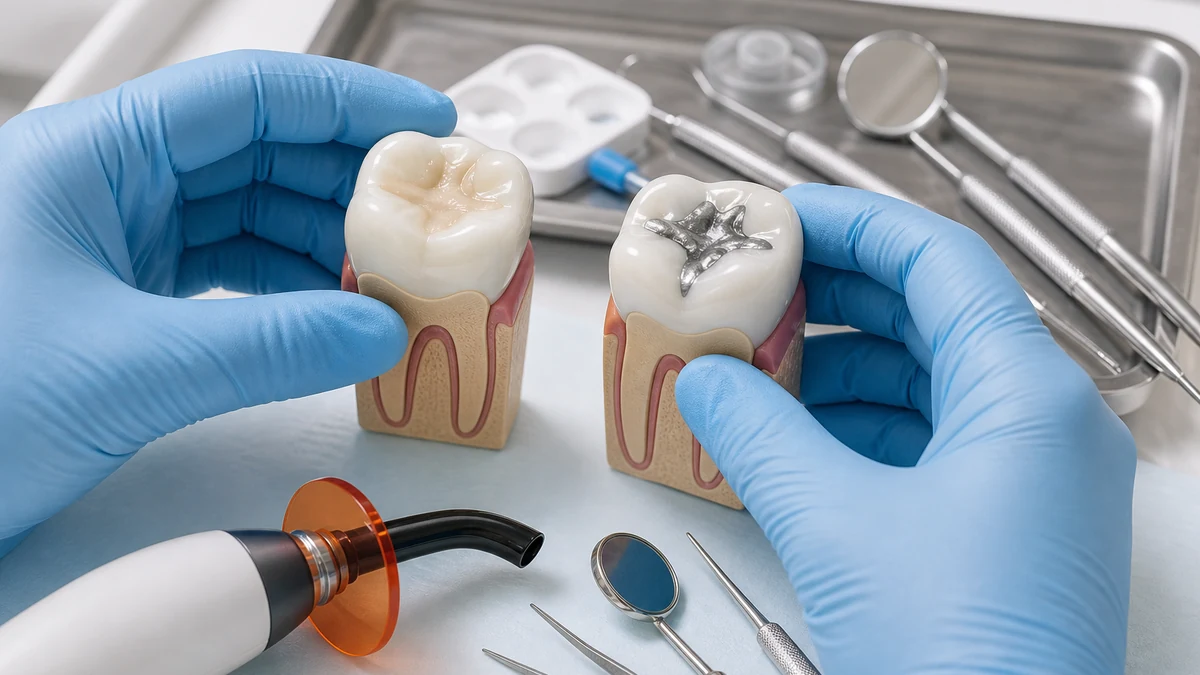
A dental filling restores a tooth damaged by decay or minor fracture, sealing the cleaned cavity and returning the tooth to its normal shape and function. The two materials patients ask about most are composite (tooth-coloured resin) and amalgam (the traditional silver filling). This guide compares composite vs amalgam fillings on durability, appearance, cost and safety, and explains why tooth-coloured composite has become the modern standard for most routine restorations in Turkey and across Europe.
What is a dental filling?
When bacteria erode enamel and dentine, they leave a cavity that will keep growing unless it is treated. A dentist removes the decayed tissue, disinfects the space and fills it with a durable material that bonds or packs into the prepared cavity. The result restores chewing function and stops further breakdown. Understanding how tooth decay forms and progresses makes it easier to see why early, well-placed fillings matter so much for long-term tooth health.
Fillings are described as direct or indirect. A direct filling, such as composite or amalgam, is shaped inside the mouth in a single visit. An indirect restoration, such as inlays and onlays, is made in a laboratory and cemented in place, and tends to be reserved for larger cavities where a simple filling would not be strong enough.
Composite vs amalgam: a side-by-side comparison
Both materials have a long clinical track record, so neither is inherently right or wrong. The practical differences come down to aesthetics, how the material attaches to the tooth, longevity and cost. The table below summarises the main points. Costs are approximate ranges only and vary by case, tooth, the size of the cavity and the clinic, so treat them as a guide rather than a quote.
| Feature | Composite (tooth-coloured) | Amalgam (silver) |
|---|---|---|
| Appearance | Matched to natural tooth shade | Silver-grey, clearly visible |
| Bonding | Bonds chemically to the tooth | Held mechanically by cavity shape |
| Tooth removed | Conservative; preserves more structure | More healthy tooth often removed for retention |
| Typical lifespan | Around 5 to 10 years with good care | Often 10 to 15 years or more |
| Best suited to | Front teeth and small to medium back cavities | Large cavities in heavy-load back teeth |
| Approximate cost (UK) | Around £90 to £250 per tooth | Around £60 to £150 per tooth |
It is worth noting that glass ionomer is a third option for small fillings, baby teeth and areas near the gum line. It releases fluoride and bonds well but is less hard-wearing than composite, so most adult fillings still come down to a choice between composite and amalgam.
Composite fillings: the modern standard
Composite resin is a blend of plastic and fine glass particles that is placed in soft layers and hardened with a curing light. Because it bonds directly to enamel and dentine, the dentist can remove less healthy tooth, which is gentler and more conservative. The shade is matched to your natural teeth, so the repair is effectively invisible. These qualities are why composite is now the default choice for most fillings, particularly anything visible when you smile or speak.
The same bonding that makes composite discreet also helps support the remaining tooth structure, and the material can be repaired or added to without replacing the whole filling. Modern resins are far more wear-resistant than early versions, which is part of why dentistry has shifted decisively towards tooth-coloured restorations over the past few decades.
Composite is not flawless. It can take a little longer to place because the cavity must be kept completely dry, and very large composite fillings in back teeth may wear or chip sooner than amalgam under years of heavy biting. Where a cavity is too large for a reliable direct filling, a dentist may suggest an indirect restoration or, for a badly broken tooth, a dental crown instead.
Amalgam fillings: the traditional option
Dental amalgam combines mercury with a silver, tin and copper alloy to form a hard, long-lasting material. It has been used for well over a century and remains durable and forgiving to place, even in a damp or hard-to-reach cavity where keeping the area dry is difficult. For large restorations in the molars, where chewing forces are highest, amalgam can outlast composite, and it is often less expensive.
Its drawbacks are mainly aesthetic and structural. The silver colour stands out, and because amalgam relies on the cavity shape rather than bonding, the dentist usually removes more sound tooth to lock it in place. Over many years some amalgam fillings can also expand slightly and contribute to small cracks in the surrounding tooth. In addition, many countries are now phasing amalgam down for environmental reasons linked to its mercury content, which is one reason tooth-coloured materials have moved to the front of routine care.
How is a filling placed?
Most direct fillings are completed comfortably in a single appointment under local anaesthetic. The exact steps vary with the material and the size of the cavity, but the general sequence is consistent.
- The area is numbed with local anaesthetic so the procedure is comfortable.
- The decayed and weakened tooth tissue is removed and the cavity is cleaned.
- The cavity is shaped and, for composite, the surface is prepared so the resin can bond.
- The material is placed, composite in light-cured layers or amalgam packed and condensed.
- The filling is shaped to match your bite, then trimmed and polished.
You can usually eat and drink soon afterwards, although it is sensible to wait until the numbness wears off so you do not bite your cheek or tongue.
Aftercare and sensitivity
Mild sensitivity to hot, cold or pressure is common for a few days after a filling and normally settles on its own. You can support healing by keeping up gentle brushing and flossing, avoiding very hard or sticky foods on a new composite for the first day, and limiting habits that stain, such as heavy coffee or smoking. Contact your dentist if sensitivity is severe, lasts beyond a couple of weeks, the filling feels high when you bite, or you notice a sharp edge or a piece coming loose, as the filling may need adjusting.
Are amalgam fillings safe?
Major health authorities consider amalgam safe for most adults, as the mercury is bound within a stable alloy and exposure is very low. Removing sound, intact amalgam fillings simply to replace them is not recommended. If you have specific concerns, discuss them with your dentist rather than acting alone.
How long do dental fillings last?
Composite fillings typically last around five to ten years, and amalgam often ten to fifteen years or longer, though both depend heavily on the size of the filling, the tooth involved, your bite and your oral hygiene. Grinding, decay around the edges and very large cavities all shorten the lifespan of any filling.
Which filling should you choose?
For small to medium cavities, especially on visible teeth, tooth-coloured composite is usually the best balance of appearance, conservation and strength, which is why it is the modern standard. For very large cavities in heavily loaded back teeth, your dentist may still recommend amalgam or a laboratory-made restoration for longevity. The right answer is case by case, so a proper examination is essential before deciding.
When should you see a dentist?
See a dentist promptly if you notice tooth sensitivity to hot, cold or sweet foods, visible holes or dark spots, food trapping in a tooth, a rough or fractured edge, or ache when biting. Caught early, decay can often be managed with a simple filling. Left untreated, it can progress to the nerve and require root canal treatment or extraction, so regular check-ups remain the simplest way to keep small problems small.
Related reading

Mehmet Kaplan
Dr. Mehmet Kaplan graduated from Istanbul University Faculty of Dentistry. Applying modern dental techniques and up-to-date treatment methods, Dr. Kaplan personalizes his treatments according to the individual needs of h…
View full profile →