
 English
 Turkce
 Deutsch
 Francais
 Russkij
 العربية
 Espanol
 Italiano
 Nederlands
 Balgarski
 Romana
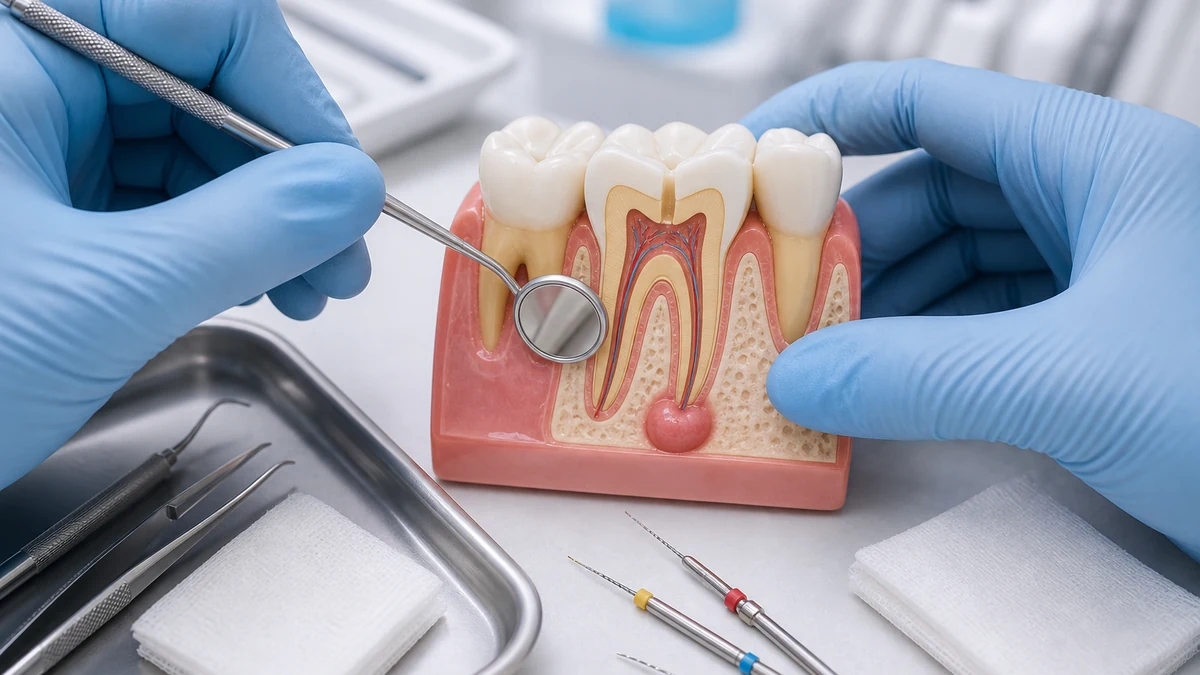
A dental abscess is a pocket of pus caused by a bacterial infection, usually forming at the tip of a tooth's root or in the gum beside it. It most often follows untreated tooth decay, gum disease or a cracked tooth, and it will not clear up on its own. A dental abscess is a genuine emergency: it needs prompt professional treatment, because the infection can spread and become dangerous if ignored.
An abscess is one of the few dental problems that should never be left to settle. The pain is often severe, but pain is not the real danger; a spreading infection is. This guide covers what a dental abscess is, what causes it, the symptoms to watch for, and how dentists treat it. One point runs throughout: an abscess needs urgent care, and the self-care steps below only keep you comfortable until you are seen.
What is a dental abscess?
A dental abscess is a collection of pus that builds up because of a bacterial infection in or around a tooth. The body walls off the infection, creating a swollen, painful pocket. It does not heal by itself and needs a dentist to drain it and treat the underlying cause.
Abscesses are grouped by where they begin, and the type affects how they are treated:
- Periapical abscess. This forms at the tip of the root, typically when bacteria reach the soft pulp through deep decay or a crack. It is the most common type.
- Periodontal abscess. This develops in the gum and bone beside a tooth, often linked to advanced gum disease or a pocket where bacteria become trapped.
- Gingival abscess. This is confined to the gum tissue, sometimes after food or a foreign object lodges under the gum line.
Whatever the type, the principle is the same: the infection must be cleared and the cause put right. An abscess will not resolve with painkillers alone, and the longer it is left, the further it can spread into surrounding bone and tissue.
What causes a dental abscess?
A dental abscess is caused by bacteria entering the tooth or gum and multiplying. The usual routes are untreated tooth decay that reaches the pulp, gum disease, a cracked or broken tooth, or a failed previous root canal. Poor oral hygiene, a sugary diet and a dry mouth all raise the risk.
In nearly every case an abscess is the end point of an earlier, untreated problem. The most common causes include:
- Untreated tooth decay. When a cavity is left to deepen, bacteria reach the pulp and infect it. Our guide on untreated tooth decay explains how a small cavity progresses to this stage.
- Gum disease. Advanced gum disease creates deep pockets between the gum and tooth where bacteria collect, which can lead to a periodontal abscess.
- A cracked, chipped or broken tooth. Damage that exposes the inner tooth gives bacteria a direct path to the pulp.
- A previous root canal. Occasionally infection returns after root canal treatment if bacteria remain or re-enter, and a failed root canal may need retreatment to clear it.
- Trauma to the tooth. A knock or injury can damage the pulp even when the tooth looks intact, and it may become infected later.
Poor brushing and flossing, a sugary diet, smoking, a dry mouth and a weakened immune system all make an abscess more likely by helping harmful bacteria thrive.
What are the symptoms of a dental abscess?
The main symptom is a severe, throbbing pain in the tooth or gum that can spread to the jaw, ear or neck. Other signs include swelling of the face or gum, tenderness, sensitivity to hot and cold, a bad taste, fever and swollen glands. Sometimes the pain eases suddenly if the abscess bursts.
Symptoms can come on quickly and tend to be more intense than an ordinary toothache. Watch for any of the following:
- An intense, throbbing pain that may keep you awake at night
- Pain that radiates to the jaw, ear, neck or the same side of the head
- Swelling in the gum, cheek or face, sometimes with a visible lump or pimple-like spot
- Redness and tenderness around the area
- Sensitivity to hot or cold, and pain when biting or chewing
- A loose or discoloured tooth
- A foul taste or smell, which can mean pus is draining
- Fever, swollen neck glands and a general feeling of being unwell
One deceptive moment is worth flagging. If a throbbing abscess suddenly stops hurting and you notice a salty or foul taste, it usually means it has burst and is draining, not healed. The infection is still present and still needs treatment, so see a dentist even if the pain has eased. Our overview of toothache and its causes covers how to tell different sources of tooth pain apart.
Is a dental abscess a medical emergency?
Yes. A dental abscess is a medical emergency because the infection can spread to the jaw, neck and beyond if it is not treated. Seek urgent care the same day, and go straight to a hospital if you have facial swelling that is spreading, a high fever, or any difficulty breathing or swallowing.
Most abscesses can be handled promptly by an emergency dentist, but certain warning signs mean you should not wait at all. Seek immediate medical help if you have:
- Swelling spreading across the face, into the neck, or towards the eye
- A high temperature, chills or a racing heartbeat
- Difficulty breathing, swallowing or fully opening your mouth
- Swelling under the tongue or in the floor of the mouth
- Confusion, a severe headache or feeling extremely unwell
Difficulty breathing or swallowing, a rapidly spreading swelling, or a high fever with a dental abscess can signal a serious, spreading infection. Do not wait for a routine appointment. Go to an accident and emergency department or call the emergency services straight away.
What can you safely do before you see a dentist?
While you arrange urgent care, you can take over-the-counter pain relief as directed on the packet, rinse gently with warm salt water, and use a cold compress on the cheek for swelling. Avoid very hot, cold or hard foods. These steps only ease discomfort; they do not treat the infection, so still see a dentist urgently.
The aim while you wait is to stay comfortable without making things worse. Safe measures include:
- Over-the-counter pain relief. Painkillers such as paracetamol or ibuprofen, taken strictly as directed on the packet, can take the edge off. Do not exceed the stated dose, and check with a pharmacist if you take other medicines.
- Warm salt-water rinses. Gently swishing warm salty water around the mouth can soothe the area and help keep it clean.
- A cold compress. Holding a cold pack against your cheek for short periods can reduce swelling and numb the pain.
- Soft foods and an upright position. Eat soft foods, avoid chewing on the affected side, and sleep with your head slightly raised, which some find eases the throbbing.
It is just as important to know what not to do. Never try to drain or burst an abscess yourself or poke it with anything sharp, as this can drive the infection deeper. Do not place an aspirin tablet against the gum, as it can burn the tissue. Do not rely on leftover antibiotics, and never let home measures become a reason to delay treatment.
How do dentists treat a dental abscess?
Treatment focuses on draining the pus and removing the source of infection. A dentist will usually drain the abscess, then either carry out root canal treatment to save the tooth or, if the tooth cannot be saved, remove it. Antibiotics may be prescribed when the infection is spreading or you are unwell.
After examining the tooth and often taking an X-ray, the dentist will choose the most appropriate approach for your case:
- Draining the abscess. The dentist makes a small opening to release the pus and pressure, which usually brings rapid pain relief.
- Root canal treatment. Where the tooth can be saved, the infected pulp is cleaned out, the canals are sealed, and the tooth is restored, often with a crown.
- Tooth extraction. If the tooth is too damaged to save, it is removed and the area cleaned so the infection can clear. Replacement options are discussed once you have healed.
- Antibiotics where needed. Antibiotics do not cure an abscess alone, but may be prescribed alongside treatment if the infection is spreading, you have a fever, or your immune system is compromised.
The key point is that draining and treating the source cures an abscess, not antibiotics alone. Caught early, it is very treatable and the tooth can often be saved. The best way to avoid one is good oral hygiene, less sugary food and drink, and regular dental visits, so that decay, cracks and gum problems are dealt with before they turn into an infection. If you ever suspect an abscess, treat it as urgent and seek professional care without delay.
Related reading

Mehmet Kaplan
Dr. Mehmet Kaplan graduated from Istanbul University Faculty of Dentistry. Applying modern dental techniques and up-to-date treatment methods, Dr. Kaplan personalizes his treatments according to the individual needs of h…
View full profile →