
 English
  Turkce
  Deutsch
  Francais
  Russkij
  العربية
  Espanol
  Italiano
  Nederlands
  Balgarski
  Romana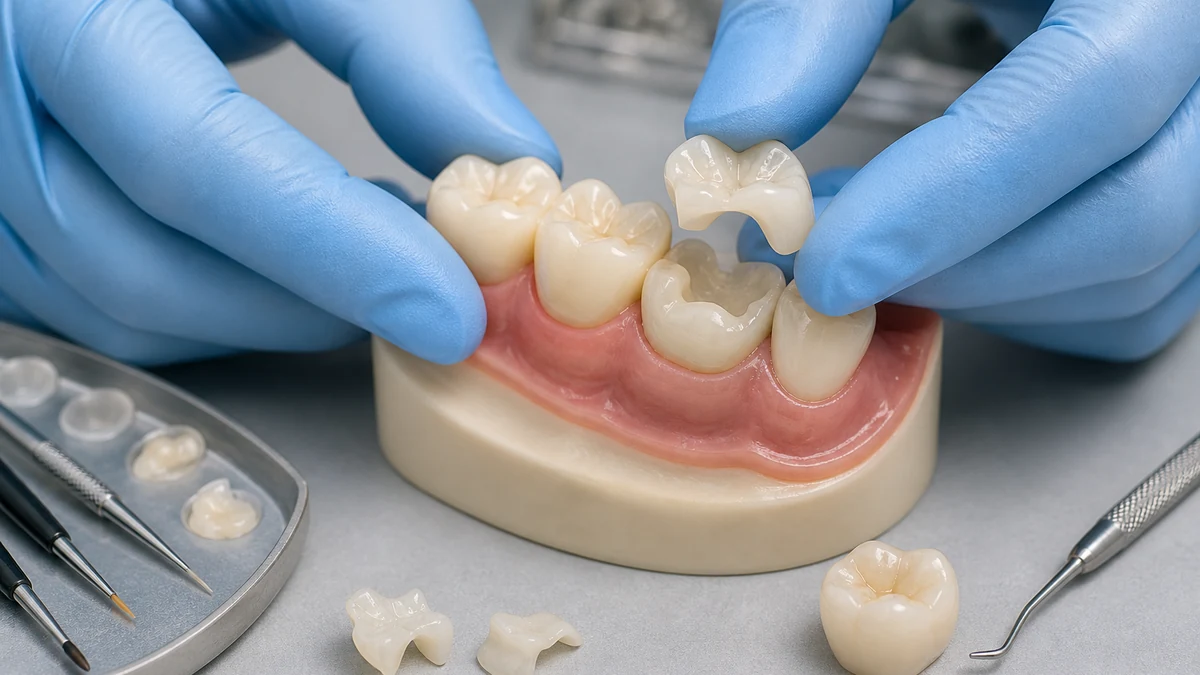
An inlay or onlay is a custom-made restoration that repairs a tooth too damaged for a simple filling but not damaged enough to need a full crown. Often called indirect fillings, inlays and onlays are made in a laboratory and then bonded into place, restoring strength to a back tooth while preserving as much healthy structure as possible. Patients researching inlays and onlays usually want to know how they differ from an ordinary filling and a crown, what they are made from and what the treatment involves. This guide explains each point clearly for anyone weighing their restorative options.
What is the difference between an inlay and an onlay?
An inlay fits inside the biting surface of a tooth, within the raised points called cusps. An onlay covers one or more of those cusps as well, wrapping over the edge. Both repair damage that is too large for a filling but does not yet justify a crown, which encases the whole tooth.
The simplest way to picture the difference is by how much of the tooth each one rebuilds. A standard filling sits directly inside a small cavity. An inlay replaces a larger area contained within the cusps. An onlay extends further, restoring one or more cusps. A crown, by contrast, covers the entire visible tooth. Inlays and onlays therefore occupy the middle ground, which is why they are sometimes described as partial crowns.
When does a tooth need an inlay or onlay instead of a filling?
A tooth usually needs an inlay or onlay when decay or a fracture is too large for a direct filling to hold reliably, but enough healthy tooth remains to avoid a full crown. They are common on molars and premolars that take heavy chewing forces, where a large filling might crack or fall out.
A dentist may recommend one of these restorations in several situations: where an old, oversized filling has failed; where a cusp has fractured; or where a cavity is wide and shallow rather than deep. Because they are made from a single solid piece of material and bonded in, inlays and onlays can actually reinforce a weakened tooth rather than wedge it apart, which is a risk with very large direct fillings. If your tooth has reached the point where a filling will no longer do the job, our overview of how cavities and tooth decay progress explains the stages that lead to this decision.
What materials are inlays and onlays made from?
Inlays and onlays are most often made from porcelain or ceramic, composite resin, or gold. The right material depends on where the tooth sits, how visible it is, the bite forces it carries and your preference on appearance and budget. Each option has clear strengths and trade-offs.
- Porcelain or ceramic: the most popular choice for its natural appearance. Modern ceramics such as lithium disilicate are strong, stain-resistant and matched to the colour of the surrounding teeth, making them almost invisible.
- Composite resin: tooth-coloured and generally more affordable than ceramic. It is a good middle option, though it can wear or discolour faster than porcelain over many years.
- Gold: the most durable material and exceptionally kind to opposing teeth, but its colour means it is now used mainly for back molars where appearance matters less.
Whichever material is chosen, the restoration is custom-made to fit the prepared tooth precisely, which is what gives inlays and onlays their tight seal and long working life.
How are inlays and onlays fitted?
Fitting an inlay or onlay traditionally takes two appointments, though some clinics now offer same-day ceramic restorations milled on site. The procedure is carried out under local anaesthetic and most patients feel only mild sensitivity for a day or two afterwards.
- Preparation: the dentist removes any decay or old filling material and shapes the cavity to receive the restoration, conserving as much healthy tooth as possible.
- Impression: a digital scan or mould of the tooth is taken so the laboratory can build a piece that matches your bite and tooth shade exactly.
- Temporary restoration: a temporary filling protects the tooth while the permanent inlay or onlay is made, usually over one to two weeks.
- Bonding: at the second visit the dentist checks the fit and colour, then bonds the restoration in place with dental cement and adjusts the bite.
Once bonded, an inlay or onlay functions just like a natural part of the tooth, and you can eat and clean normally straight away.
What are the benefits and drawbacks?
The main benefits of inlays and onlays are strength, a precise fit and the preservation of healthy tooth structure. Because they are made and hardened in a laboratory rather than set inside the mouth, they resist shrinkage and tend to seal the tooth more reliably than a very large direct filling. They also look natural when made from ceramic or composite and are easy to keep clean.
There are honest trade-offs to weigh. The treatment costs more than a standard filling and usually takes two visits rather than one. As with any restoration, the underlying tooth can still develop decay at the margins if oral hygiene slips, so careful brushing and flossing remain essential. In cases where too little healthy tooth is left, a crown may still be the safer long-term choice, and a dentist will say so honestly. For comparison, our guide to the dental crown procedure outlines when full coverage becomes the better option.
A well-fitted ceramic or gold onlay can last 15 years or more with good oral hygiene and regular check-ups, though its lifespan depends heavily on the bite forces it carries and how well the tooth is cleaned.
When should you see a dentist?
You should see a dentist if a tooth feels sensitive to hot, cold or pressure, if an old filling feels rough or loose, or if you notice a chip or crack in a back tooth. Early assessment often means a smaller, simpler restoration rather than a crown or root canal later.
Pain when biting, a persistent ache, or food repeatedly trapping in one spot can all signal that an existing filling is failing or that decay is spreading beneath it. Catching the problem early is what keeps you in inlay-or-onlay territory rather than needing more extensive work. Regular check-ups allow a dentist to spot weakening fillings before they fracture, which is one of the simplest ways to protect a tooth. If a back tooth has already chipped, our guidance on a chipped or broken tooth and the repair options covers what to do next.
How much do inlays and onlays cost?
The cost of an inlay or onlay depends on the material, the size of the restoration and the tooth involved. In the UK they typically range from around £250 to £700 per tooth, while in the United States the figure is often higher. Ceramic and gold restorations sit at the upper end, with composite usually more affordable.
| Material | UK approx. | Turkey approx. |
|---|---|---|
| Composite resin | £200–£400 | £80–£180 |
| Porcelain / ceramic | £350–£700 | £150–£300 |
| Gold | £400–£900 | £200–£450 |
Turkey is consistently more affordable than the UK or US, largely because of lower clinic running costs and a well-developed dental-tourism sector, not because of any drop in standards. The figures above are approximate ranges and vary by case; a clinic can only confirm a price after examining the tooth or reviewing clear photographs. At Seren Klinik our specialist team assesses how much healthy tooth remains and recommends the most conservative restoration that will last, whether that is an inlay, an onlay or, where genuinely needed, a crown.
Related reading

Mehmet Kaplan
Dr. Mehmet Kaplan graduated from Istanbul University Faculty of Dentistry. Applying modern dental techniques and up-to-date treatment methods, Dr. Kaplan personalizes his treatments according to the individual needs of h…
View full profile →