
 English
  Turkce
  Deutsch
  Francais
  Russkij
  العربية
  Espanol
  Italiano
  Nederlands
  Balgarski
  Romana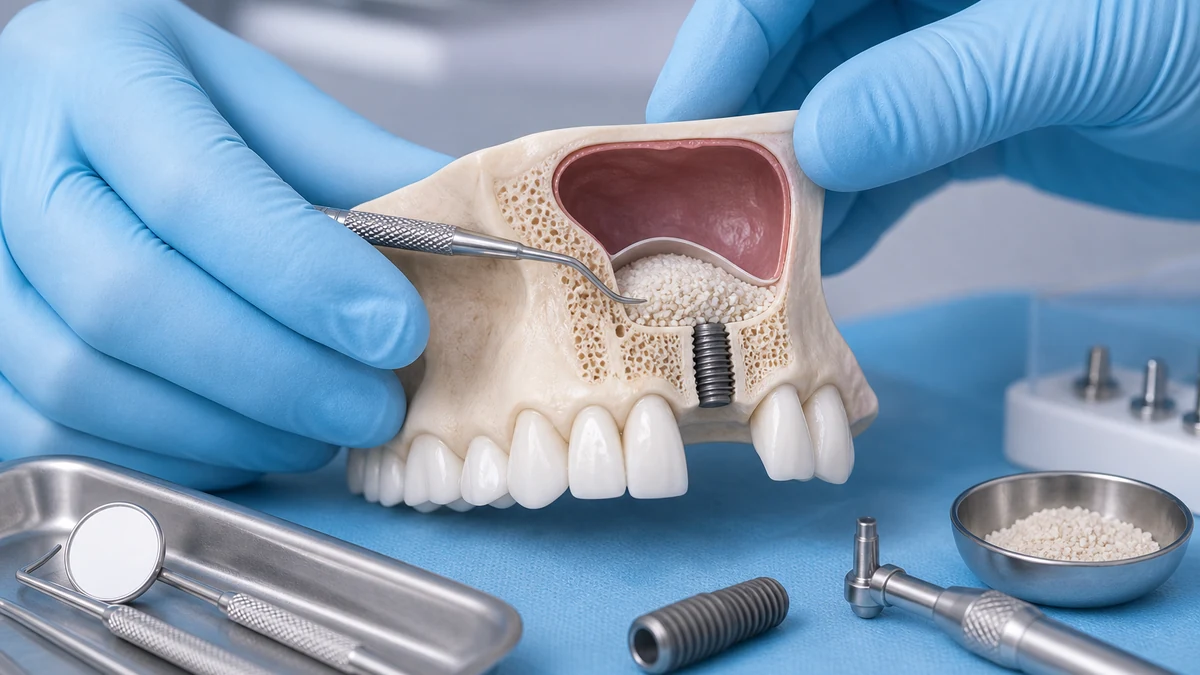
A sinus lift for dental implants is a minor bone-grafting procedure that adds height to the upper jaw when there is not enough natural bone to anchor an implant. Also called sinus augmentation, it lifts the membrane lining the maxillary sinus and packs grafting material into the space below it. For patients exploring dental implants in Turkey, a sinus lift is one of the most common preparatory steps when upper back teeth are being replaced, and understanding why and when it is needed helps you plan treatment realistically.
What is a sinus lift and why is it needed?
A sinus lift creates more usable bone in the upper jaw by raising the floor of the maxillary sinus and filling the gap with bone graft. It is needed because dental implants must be surrounded by enough bone to stay stable, and the upper back jaw often lacks that volume.
The maxillary sinuses are two air-filled spaces that sit directly above your upper back teeth. When a tooth in this area is lost, the bone that once held its root begins to shrink, a process called resorption. Over months and years the sinus can also expand downward into the empty space. The result is a thin shelf of bone, sometimes only a few millimetres deep, which is not enough to hold an implant securely. A sinus lift restores that lost height so an implant of adequate length can be placed.
How bone loss affects upper implants
The upper jaw is naturally less dense than the lower jaw, and the back region is the most affected by resorption. Even patients with healthy gums can lose significant bone within the first year after an extraction. This is why a tooth replaced soon after removal sometimes needs less grafting than one that has been missing for years.
When is a sinus lift recommended?
A sinus lift is recommended when imaging shows that the bone height below the sinus is too low to support an implant safely, typically under roughly 8 to 10 millimetres, and the patient wants fixed implants rather than a removable option in the upper back jaw.
Your specialist will not decide this by looking in your mouth alone. The procedure is planned from a three-dimensional cone-beam CT scan, which measures the exact bone height, the position of the sinus, and the thickness of its lining. Common situations that lead to a recommendation include:
- Long-term tooth loss in the upper back jaw with noticeable bone shrinkage.
- Naturally large or low-hanging sinuses that leave little bone beneath them.
- Bone loss from advanced gum disease around former teeth.
- Replacing several adjacent upper molars where stability matters most.
If you are weighing fixed teeth against other routes, it can help to read about full-arch options such as the All-on-4 implant technique, which is sometimes designed to angle implants and avoid the sinus altogether.
How is a sinus lift performed?
A sinus lift is performed under local anaesthetic, often with sedation, by lifting the sinus membrane and placing bone graft beneath it. The two main approaches are the lateral window technique for larger lifts and the less invasive crestal technique for smaller ones.
The general steps are as follows:
- The area is numbed and, where appropriate, sedation is offered for comfort.
- For a lateral lift, the surgeon makes a small opening in the side wall of the jaw to reach the sinus.
- The thin membrane lining the sinus is gently raised upward to create space.
- Bone graft, which may be your own bone, donor bone, or a synthetic substitute, is packed into the space.
- The site is closed with stitches and left to heal so new bone can form.
In some cases, when there is already a moderate amount of bone, the implant can be placed during the same appointment as the lift. When bone is very thin, the graft is given several months to mature first, and the implant is placed at a later visit. Your specialist team will advise which sequence suits your anatomy.
Bone graft materials explained
Several graft materials are used successfully and the choice depends on your case. Your own bone integrates predictably, donor and animal-derived grafts act as a scaffold that your body replaces over time, and synthetic granules avoid the need for a second surgical site. All are widely used and considered safe for this purpose.
What does recovery from a sinus lift involve?
Recovery from a sinus lift usually means mild swelling and tenderness for a few days, managed with standard pain relief. Most people return to routine activities quickly, but the grafted bone needs several months to mature before an implant can rely on it.
To protect the graft while it settles, your specialist will typically advise that you avoid blowing your nose forcefully, sneeze with your mouth open, and skip strenuous exercise, flying, or drinking through a straw for a short period. Minor nosebleeds or a feeling of congestion on the treated side can occur and usually pass. A short course of antibiotics and a saline rinse may be recommended to keep the area clean.
What are the risks of a sinus lift?
The most common complication of a sinus lift is a small tear in the sinus membrane, which a surgeon can usually repair during the same procedure. Less often, infection or graft failure can occur, but serious problems are uncommon when the surgery is well planned.
No surgical procedure is risk-free, and an honest conversation about complications is part of good care. A torn membrane may simply be patched and allowed to heal, sometimes with the lift completed at a later date. Infection is managed with antibiotics. Rarely, a graft does not integrate and the procedure has to be repeated. Choosing an experienced oral surgeon, following aftercare instructions, and not smoking all lower these risks meaningfully.
How much does a sinus lift cost?
A sinus lift is usually priced in addition to the implant itself. Costs vary by case, but in the UK a sinus lift often falls in the region of £1,500 to £2,500 or more, while in Turkey the equivalent procedure is typically a fraction of that. Prices are approximate and vary by the amount of grafting required.
The final figure depends on whether one or both sides are treated, the technique used, and the graft material chosen. Because the upper jaw frequently needs grafting, the overall plan for upper-arch implants can involve more steps than a straightforward case, which is worth factoring into your budget. If you are comparing tooth-replacement routes, you may also want to understand when a dental bridge might avoid surgery entirely, though a bridge does not address bone loss the way an implant does.
Is a sinus lift always necessary for upper implants?
No. A sinus lift is only necessary when bone height is insufficient. Where enough bone remains, or where shorter or angled implants can be used, the procedure may be avoided. Your scan and specialist assessment determine the right approach for your jaw.
Modern planning gives surgeons several ways to work around limited bone, including tilted implants and, in selected cases, shorter implants that still achieve good stability. These options are not suitable for everyone, which is why a thorough evaluation matters. The goal is always a result that is stable and built to last with good long-term care, rather than the fewest possible appointments.
A sinus lift is not a setback. It is a well-established way to give an upper implant the solid foundation it needs to function for many years.
If you have been told you may need a sinus lift, treat it as a normal and predictable part of upper-jaw implant treatment. With careful planning, an experienced surgical team, and realistic expectations about healing time, it is a routine step on the way to fixed, natural-feeling teeth.
Related reading

Mahir Yılmaz
Dr. Mahir Yılmaz graduated from Istanbul University Faculty of Dentistry. He has extensive academic knowledge and clinical experience in general and restorative dentistry. With many years of professional experience, Dr. …
View full profile →