 English
  Turkce
  Deutsch
  Francais
  Russkij
  العربية
  Espanol
  Italiano
  Nederlands
  Balgarski
  Romana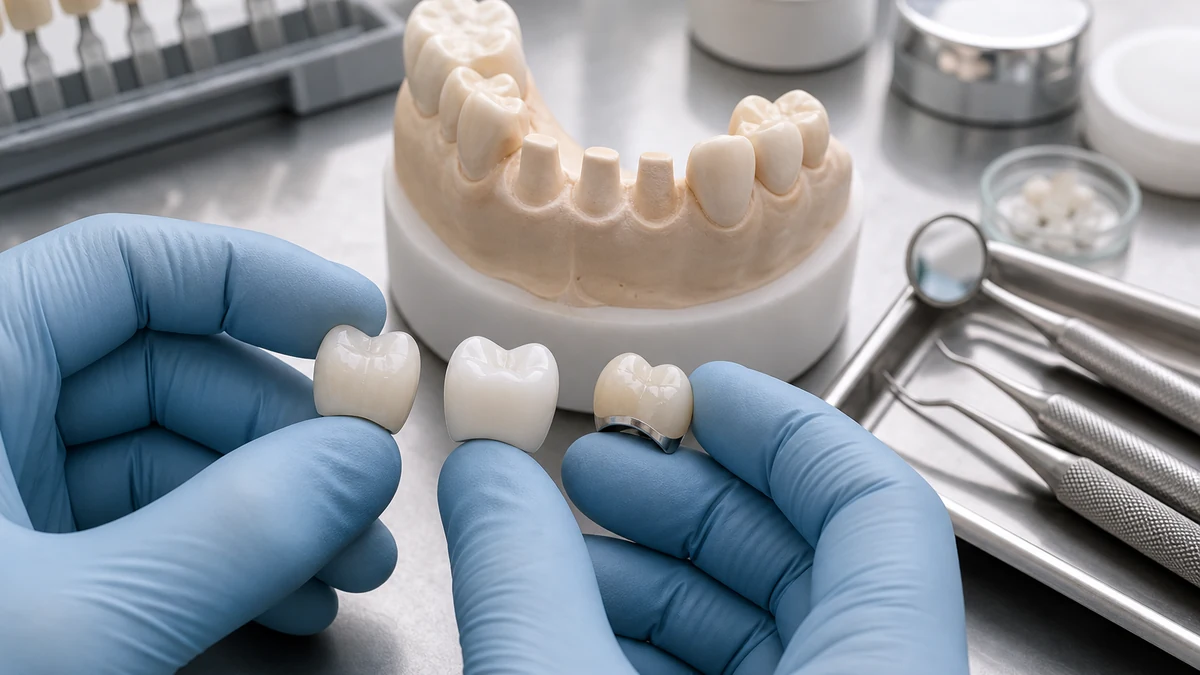
Choosing a dental crown often comes down to three materials: zirconia, E-max (lithium disilicate) and traditional metal-ceramic. A crown is a custom cap that covers a damaged, root-treated or heavily restored tooth to rebuild its shape, strength and appearance. The right choice depends on where the tooth sits in your mouth, how much chewing force it takes and how natural you need it to look. This guide compares zirconia vs E-max vs metal-ceramic crowns across strength, aesthetics, cost and longevity, so you can have an informed conversation with your dentist about which dental crown is right for your case.
Zirconia vs E-max vs metal-ceramic crowns: side-by-side comparison
The table below summarises the main practical differences. Costs are approximate, vary by case and country, and tend to be significantly lower in Turkey than in the UK or US. Treat these figures as general guidance rather than a quote, since the best material depends on the individual tooth.
| Factor | Zirconia | E-max (lithium disilicate) | Metal-ceramic (PFM) |
|---|---|---|---|
| Core material | Zirconium dioxide ceramic | Glass-ceramic | Metal base under porcelain |
| Strength | Very high, resists fracture | High, excellent for front teeth | High, proven track record |
| Aesthetics | Natural, very good to excellent | Most lifelike, highly translucent | Good, can show a dark gumline |
| Best suited to | Back teeth, bridges, grinders | Front teeth, single crowns, veneers | Budget cases, longer bridges |
| Metal content | Metal-free | Metal-free | Contains a metal alloy |
| Typical lifespan | Often 10 to 15+ years | Often 10 to 15+ years | Often 10 to 15+ years |
| Approximate cost | Mid to higher | Higher (premium aesthetics) | Usually the most affordable |
What is the difference between zirconia, E-max and metal-ceramic crowns?
The core difference is the material. Zirconia crowns are milled from a tough white ceramic, E-max crowns are made from a translucent glass-ceramic prized for its lifelike look, and metal-ceramic crowns layer porcelain over a metal base for strength. Each balances durability and appearance differently.
Metal-ceramic crowns, also called porcelain-fused-to-metal (PFM), are the long-standing classic. The metal substructure makes them strong and reliable, but the metal can occasionally show as a faint dark line near the gum, especially if the gum recedes over time. Zirconia and E-max are both metal-free, so they avoid that grey margin and suit patients who prefer ceramic restorations. Within the metal-free group, zirconia leans towards maximum strength while E-max leans towards maximum beauty, which is why dentists often reserve each for different teeth.
Which crown material is the strongest?
Zirconia is generally the strongest of the three. It resists chipping and fracture exceptionally well, which makes it a dependable choice for molars, for patients who grind or clench, and for multi-unit bridges that carry heavy load. Metal-ceramic is also strong, while E-max is robust but better suited to front teeth.
Strength matters most at the back of the mouth, where biting forces are highest. For these high-load areas, many dentists favour full-contour zirconia because it can be made as a single solid piece with no porcelain layer to chip. Metal-ceramic remains a sturdy, well-proven option, particularly for longer bridges. E-max is strong for its class and excellent for single crowns and front teeth, but it is not usually the first choice for heavy-duty molar bridges. Your dentist will weigh your bite, the tooth position and any grinding habit before recommending a material.
Which crowns look the most natural?
E-max crowns usually look the most natural because their glass-ceramic is highly translucent and mimics the way light passes through real enamel. Zirconia has become very lifelike too, especially modern high-translucency types. Metal-ceramic looks good but can appear slightly more opaque and may show a dark gumline.
For a front tooth on show when you smile, E-max is often the aesthetic benchmark, giving depth and a lively, enamel-like finish. High-translucency zirconia now comes close and offers more strength, so it is a popular compromise for visible teeth that still need to be tough. Metal-ceramic can be made to look attractive, but the opaque layer that hides the metal core makes it harder to achieve the same translucency, and the metal edge can become visible if gums recede. If you are planning a full smile makeover rather than a single crown, it is worth reading how crowns fit into a wider Hollywood smile in Turkey, where material choice is matched carefully to each tooth.
How much do zirconia, E-max and metal-ceramic crowns cost?
Metal-ceramic crowns are usually the most affordable, with zirconia in the mid to higher range and E-max often the most expensive for its premium aesthetics. As a rough, evergreen guide, a single crown in Turkey might fall in a broad range of roughly £120–£350 depending on material, while UK prices are typically several times higher.
These figures are approximate and vary by case, clinic and the number of teeth involved, so always confirm what a price includes, such as the consultation, any core build-up and follow-up checks. Turkey is significantly more affordable than the UK or the United States for crown work without that meaning lower standards, which is why many international patients travel for treatment. Material is only one part of the cost: the underlying tooth may also need root canal treatment or a build-up first. If you are comparing crowns with thinner facings for cosmetic cases, our guide to porcelain versus composite veneers explains how veneers differ from full crowns in cost and tooth preparation.
How are dental crowns fitted?
Fitting a crown usually takes two visits. At the first, the dentist shapes the tooth, takes an impression or a digital scan, and fits a temporary crown while the permanent one is made. At the second, the temporary is removed and the final crown is checked for fit, bite and colour before being cemented in place.
Tooth preparation involves removing a thin layer of the natural tooth so the crown can sit over it, which is irreversible, so it is worth understanding before you proceed. Some clinics with in-house milling can produce certain ceramic crowns, such as E-max or zirconia, in a single day, though many cases still benefit from a laboratory finish for the most natural result. Whichever material you choose, careful colour matching and bite adjustment are what make a crown feel and look like your own tooth.
Which crown should you choose, and when?
The right choice depends on the tooth and your priorities. Choose E-max when appearance is paramount and the tooth is a single front crown. Choose zirconia for back teeth, bridges or if you grind, where strength matters most. Choose metal-ceramic when budget is the main concern or for certain longer bridges.
In practice, many treatment plans mix materials: E-max or high-translucency zirconia on the visible front teeth for beauty, and solid zirconia on the molars for durability. Metal-ceramic still has a valuable role where cost is decisive or the engineering of a long bridge favours a metal frame. There is no single best crown, only the one that best fits the specific tooth, your bite and your goals. If you are weighing crowns against thinner alternatives for purely cosmetic changes, comparing them with E-max veneers in Turkey can help you see when a full crown is genuinely needed versus when a more conservative option will do. An honest, in-person assessment from a qualified dentist is the best way to match the material to your case.
Frequently asked questions
Are zirconia crowns better than E-max?
Neither is universally better. Zirconia is stronger and ideal for back teeth, bridges and grinders, while E-max is more translucent and often the most natural choice for single front crowns. The right pick depends on the tooth position, your bite and how much it shows when you smile.
Do metal-ceramic crowns show a dark line?
They can. The metal core under the porcelain may show as a faint dark line near the gum, particularly if the gum recedes over the years. Metal-free zirconia and E-max crowns avoid this, which is one reason they are often preferred for highly visible front teeth.
How long do dental crowns last?
Well-made crowns of any of these materials can often last 10 to 15 years or more with good oral hygiene and regular check-ups. No crown is permanent, and lifespan depends on the underlying tooth, your bite, grinding habits and gum health rather than the material alone.

Berkan Tik
Dentist Berkan Tik graduated from Istanbul University Faculty of Dentistry. He has worked in various clinics focusing on implantology, prosthetic dental treatments, aesthetic dentistry, and digital dentistry applications…
View full profile →