 English
  Turkce
  Deutsch
  Francais
  Russkij
  العربية
  Espanol
  Italiano
  Nederlands
  Balgarski
  Romana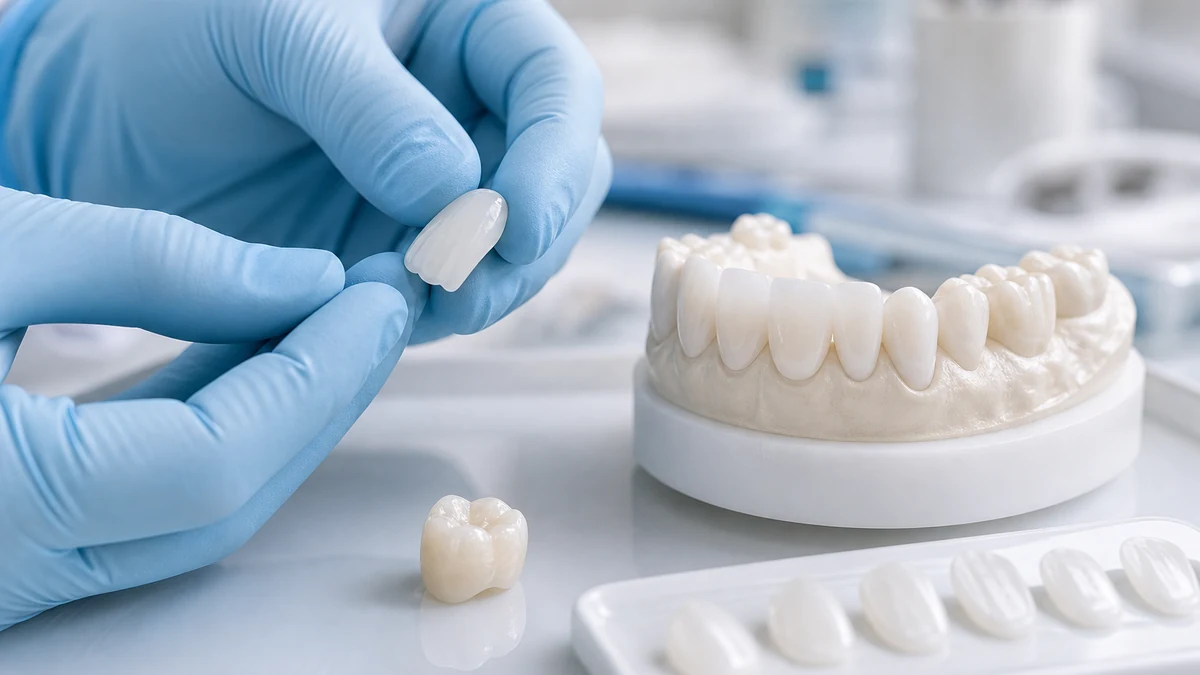
E-max veneers in Turkey are thin shells of lithium disilicate ceramic bonded to the front of your teeth to reshape colour, shape, and alignment. Often called premium porcelain veneers, E-max is a glass-ceramic prized for its natural translucency and strength, which is why many patients travelling to Istanbul for a smile makeover ask for it by name. This guide explains what E-max veneers are, who suits them, how the treatment works, the realistic costs, and the honest considerations every patient should weigh before booking.
What are E-max veneers?
E-max is a brand of lithium disilicate, a high-strength glass-ceramic developed by Ivoclar Vivadent. An E-max veneer is a wafer-thin facing, typically around 0.3 to 0.5 mm, that is custom-milled or pressed and then bonded to a natural tooth. Compared with older feldspathic porcelain, lithium disilicate combines respectable flexural strength with the light-handling properties of natural enamel.
The material can be used as a monolithic veneer (one solid block of ceramic) or layered with porcelain for extra characterisation on front teeth. Because the ceramic transmits light in a way that mimics enamel, well-made E-max veneers tend to avoid the flat, opaque look that gives some makeovers away. They are a core option within most cosmetic plans, and you can compare them with other materials in our guide to porcelain versus composite veneers before deciding.
How E-max differs from zirconia and composite
Zirconia is stronger and more opaque, which suits crowns and heavily worn teeth but can look less lifelike on thin front veneers. Composite bonding is cheaper and reversible but stains and chips sooner. E-max sits in the middle: strong enough for most veneer cases, with superior aesthetics for the visible smile zone.
Who is a good candidate for E-max veneers?
Good candidates have reasonably healthy teeth and gums, enough enamel for bonding, and cosmetic concerns such as discolouration, minor chips, small gaps, or mild misalignment. E-max veneers can dramatically improve the look of teeth that whitening alone cannot correct, and they work well for patients who want a durable, natural-looking result.
You may not be an ideal candidate if you have active gum disease, untreated decay, very little remaining enamel, or a heavy grinding habit (bruxism) that is not managed. Severe crowding or bite problems are often better addressed first with orthodontics, sometimes followed by veneers. A specialist assessment, ideally with photographs and a digital preview, confirms whether E-max is the right material for your case.
- Stained or discoloured teeth that resist whitening
- Small chips, cracks, or worn edges
- Minor gaps or slightly uneven tooth shape
- A desire for a brighter, more uniform smile zone
How does the E-max veneer procedure work?
Treatment usually spans two visits over several days, which is why many international patients complete it in a single trip to Turkey. The process is methodical, and a careful clinic will not rush the planning stage, because the design decisions made early on shape the final result.
- Consultation and design. The dentist examines your teeth, takes scans or impressions, and plans the smile, often using digital design so you can preview the proposed shape and shade.
- Preparation. A thin layer of enamel is gently reduced to make room for the veneer. E-max veneers generally need only minimal preparation, which helps preserve natural tooth structure.
- Temporaries. Provisional veneers protect the prepared teeth while the laboratory crafts the permanent ones.
- Fitting and bonding. Once milled and characterised, each E-max veneer is checked for fit and colour, then bonded with dental adhesive and cured.
For a fuller smile transformation involving many teeth, the same workflow underpins a complete makeover; you can read how an entire case is planned in our overview of dental veneers in Turkey.
What are the benefits of E-max veneers?
The main draw is appearance. Lithium disilicate handles light much like enamel, giving a lifelike translucency that is hard to match with more opaque materials. Beyond looks, E-max offers a strong balance of durability and aesthetics, and its bonding chemistry helps the veneer adhere reliably to the tooth.
- Natural aesthetics: translucency and shade depth that mimic real enamel.
- Strength: good resistance to everyday biting forces when properly bonded.
- Stain resistance: the glazed ceramic surface resists coffee, tea, and wine staining better than composite.
- Conservative preparation: thin veneers can mean less enamel removal than crowns.
E-max is often chosen when a patient wants the most natural-looking result in the visible smile zone without moving to a fully opaque material.
What are the risks and considerations?
Veneers are a permanent commitment in one important sense: the small amount of enamel removed during preparation does not grow back, so the tooth will usually need some form of restoration from then on. Honest planning means understanding the trade-offs, not just the highlights.
Possible considerations include short-term sensitivity to hot and cold after preparation, the rare chance of a veneer chipping or debonding, and the reality that veneers do not stop gum recession or decay at the margins. People who grind their teeth may need a night guard to protect the ceramic. Veneers also do not whiten over time, so the surrounding natural teeth should be shade-matched thoughtfully. With good oral hygiene and regular check-ups, quality E-max veneers can last many years, and studies suggest well-bonded porcelain veneers typically perform reliably over a decade or more, though no result is guaranteed for life.
How much do E-max veneers cost in Turkey?
Prices vary by case, number of veneers, and clinic, so treat any figure as approximate and confirm your own quote at consultation. As a general guide, E-max veneers in Turkey are widely considered significantly more affordable than equivalent treatment in the UK, the US, or much of Western Europe, without that lower price implying lower-quality dentistry elsewhere.
| Location | Approx. cost per E-max veneer |
|---|---|
| Turkey | £180–£350 |
| United Kingdom | £700–£1,200 |
| United States | £700–£1,500 |
These ranges are approximate and vary by case; complex smiles, additional treatments, and the number of veneers all affect the total. For a broader view of how treatment budgets compare across procedures, see our breakdown of dental treatment costs in Turkey.
Why consider Turkey and Seren Klinik?
Turkey has become a leading destination for cosmetic dentistry thanks to experienced specialists, modern laboratories, and combined treatment-and-travel value. At Seren Klinik, our specialist team plans each smile individually, using digital design where helpful and prioritising healthy, natural-looking outcomes over a one-size-fits-all bright white. The goal is a result that suits your face, not just your teeth.
As with any cosmetic treatment, the most important step is an honest assessment of whether E-max veneers are right for you, and what realistic outcome to expect. A reputable clinic will tell you when a simpler or different option would serve you better.
Frequently asked questions
Are E-max veneers better than zirconia?
Neither is universally better; they suit different jobs. E-max offers superior translucency for natural-looking front veneers, while zirconia is stronger and more opaque, making it better for crowns, heavily worn teeth, or patients who grind. Your dentist matches the material to your case.
How long do E-max veneers last?
With good oral hygiene, regular dental check-ups, and care to avoid biting very hard objects, quality E-max veneers can last many years and often a decade or more. Longevity depends on bonding quality, your bite, and habits such as grinding, so no fixed lifespan is guaranteed.
Do E-max veneers damage your teeth?
Veneers require a thin layer of enamel to be removed, which does not regrow, so the tooth will usually need a restoration thereafter. When well planned and fitted, E-max veneers protect the front of the tooth, but they do not prevent decay or gum problems, so daily hygiene still matters.
Can E-max veneers stain or discolour?
The glazed ceramic surface of E-max resists staining from coffee, tea, and red wine far better than composite bonding. The veneers themselves do not whiten with bleaching, however, so it is sensible to agree your target shade before treatment and maintain good hygiene afterwards.

Berkan Tik
Dentist Berkan Tik graduated from Istanbul University Faculty of Dentistry. He has worked in various clinics focusing on implantology, prosthetic dental treatments, aesthetic dentistry, and digital dentistry applications…
View full profile →