
 English
  Turkce
  Deutsch
  Francais
  Russkij
  العربية
  Espanol
  Italiano
  Nederlands
  Balgarski
  Romana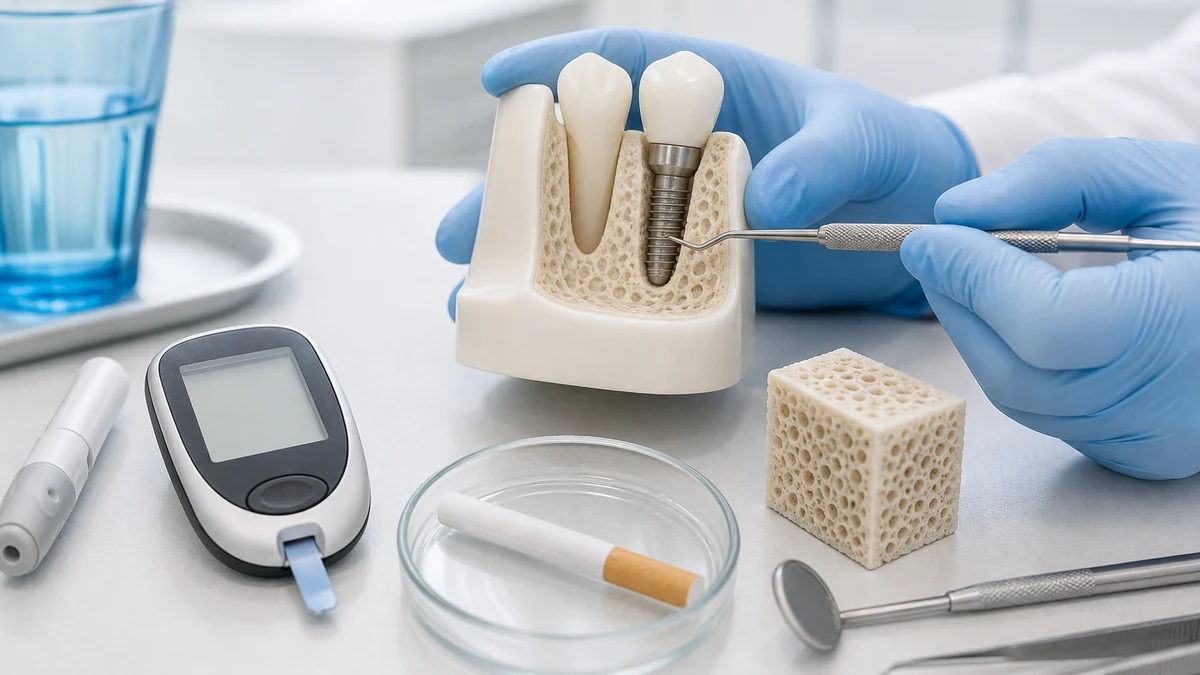
Can you have dental implants with diabetes, smoking, or bone loss? In many cases, yes, but these three factors are the most common reasons implant treatment is delayed, modified, or occasionally advised against. Dental implants in Turkey are popular with international patients, yet success depends on more than the surgery itself. Whether you have type 1 or type 2 diabetes, smoke, or have lost jawbone after missing teeth, your general and oral health directly affects how well an implant heals and lasts. Below, our oral and maxillofacial surgery team explains how each risk factor works, and what makes treatment safer rather than riskier.
How does diabetes affect dental implants?
Diabetes does not automatically rule out implants. The key factor is blood-sugar control. Well-managed diabetes is associated with implant success rates close to those of people without diabetes, whereas poorly controlled diabetes raises the risk of slow healing and infection.
High blood glucose can impair the way bone heals around an implant, a process called osseointegration, and can make gum infections more likely. People with consistently poor control are also more prone to gum disease, which undermines the foundation implants rely on. For this reason, most surgeons want to see stable, well-controlled diabetes, often reflected in a recent HbA1c reading, before placing implants. If your control is currently poor, the safest path is usually to improve it first with your doctor, then proceed. This protects both the implant and your wider health, and it does not mean implants are off the table, only that timing and preparation matter.
Can I get dental implants if I smoke?
You can be offered implants as a smoker, but smoking measurably lowers success and raises complication rates. Tobacco reduces blood flow to the gums and bone, slows healing, and increases the risk of infection and early implant failure, particularly in the upper jaw.
The damage is dose-related, so heavy smokers face the highest risk. The encouraging part is that risk is partly reversible. Many surgeons ask patients to stop smoking for a period before surgery and during the critical healing weeks afterwards, which can meaningfully improve outcomes. Smoking also contributes to gum disease and bone loss over time, so it affects long-term implant survival as well as initial healing. Vaping is sometimes assumed to be risk-free, but the evidence is still limited, so it is worth discussing honestly with your surgeon rather than assuming it is safe. A responsible clinic will raise smoking openly rather than ignore it, because pretending it does not matter is not in your interest.
Can you have implants with bone loss in the jaw?
Often yes, even when bone is limited. Implants need enough healthy bone for stability, but modern techniques can rebuild or work around deficient areas. The right approach depends on how much bone you have and where it is missing, which is assessed with a 3D CT scan.
Jawbone naturally shrinks after teeth are lost or removed, and advanced gum disease accelerates this. Where bone is insufficient, options include bone grafting to add volume, a sinus lift to create height in the upper back jaw, or angled and longer implants that engage the bone that remains. In more severe cases, specialised solutions such as implants anchored in the cheekbone may be considered. The amount of bone loss is graded from your scan, and mild deficits often need little or no grafting while larger ones do. None of this is one-size-fits-all, and a thorough assessment is what determines whether grafting, an alternative implant design, or a different treatment altogether is the safest choice for you.
What about combined risk factors?
Risk factors rarely appear alone. A patient who smokes and has poorly controlled diabetes, for example, faces a higher combined risk than either factor on its own, because both impair healing and immune response. This does not mean treatment is impossible, but it does mean planning must be more cautious.
When several factors overlap, a responsible surgeon weighs them together rather than ticking boxes individually. Age, certain medications, and gum health are part of the same picture. The plan might involve staged treatment, optimising health beforehand, choosing a more conservative implant approach, or, in some cases, recommending an alternative such as a bridge or denture. The goal is a durable, safe result, not simply placing implants at any cost.
How clinics reduce these risks
Good clinics manage risk before, during and after surgery rather than relying on luck. The most important steps are thorough assessment and honest communication about what each factor means for you. Typical risk-reduction measures include:
- Detailed medical history and, where relevant, liaison with your doctor about diabetes control or medication.
- 3D CT imaging to map bone volume, nerves and sinuses, and to plan implant positions precisely.
- Pre-treatment optimisation, such as improving blood-sugar control or a period of smoking cessation.
- Treating gum disease first so implants sit in a healthy environment.
- Bone grafting or alternative implant designs when bone is limited.
- Clear aftercare guidance on cleaning, diet, follow-up visits and avoiding smoking during healing.
These principles apply whether you need a single tooth implant or a full-arch restoration. Following the aftercare advice is just as important as the surgery itself, because long-term implant survival depends heavily on healthy gums and good daily cleaning. You can explore the full range of options on our dental implants in Turkey page.
When to seek an individual assessment
If you have diabetes, smoke, or know you have lost jawbone, the most useful next step is a proper clinical assessment rather than a yes-or-no answer online. Every case is different, and the same condition can carry very different risk depending on its severity and how well it is controlled.
As surgeons, we would rather optimise your health first, or modify the plan, than place an implant where the conditions are not right for it to last.
A trustworthy clinic will review your medical history, take the necessary scans, and tell you honestly whether implants are suitable now, suitable after some preparation, or not the best option for you. That candour is a good sign. Beware any provider that promises guaranteed success regardless of your health, because no responsible surgeon can make that promise. With the right preparation, many people with diabetes, a smoking history, or bone loss go on to have successful, long-lasting implants.
Mahir Yılmaz
Dr. Mahir Yılmaz graduated from Istanbul University Faculty of Dentistry. He has extensive academic knowledge and clinical experience in general and restorative dentistry. With many years of professional experience, Dr. …
View full profile →