
 English
  Turkce
  Deutsch
  Francais
  Russkij
  العربية
  Espanol
  Italiano
  Nederlands
  Balgarski
  Romana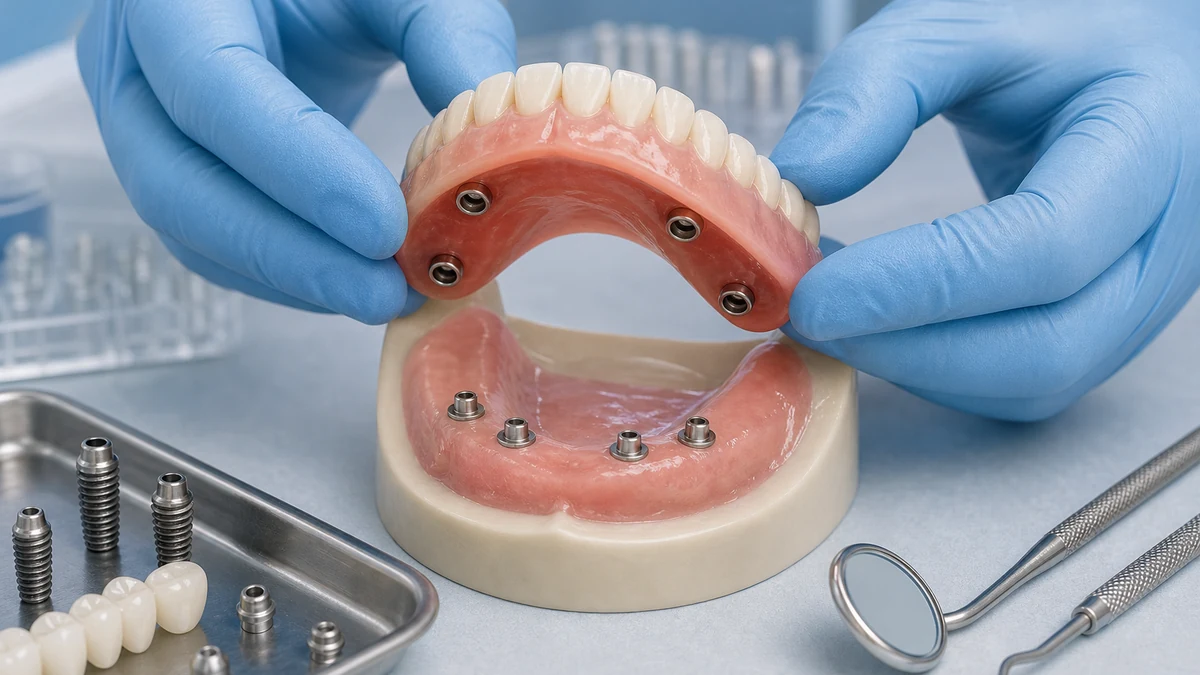
Implant-retained dentures in Turkey offer a secure alternative to traditional dentures by anchoring a removable denture onto a small number of dental implants placed in the jaw. Also called implant-supported or snap-in dentures, these implant dentures clip firmly into place, yet you still take them out for cleaning. For anyone in Istanbul or travelling for treatment who struggles with a loose lower plate, this approach restores much of the stability and confidence of natural teeth without the cost of a full fixed bridge.
Traditional dentures rest on the gums and rely on suction or adhesive paste. Implant-retained dentures are different: two or more implants act as studs, and the denture snaps onto them. This single change addresses the most common complaint about conventional plates, which is movement while eating or speaking.
What are implant-retained dentures?
Implant-retained dentures are removable dentures that attach to dental implants using small connectors. Typically two to four implants per jaw hold the denture, which clips on and off. They combine the lower cost of a removable plate with much of the stability that comes from implant anchorage.
The implants are titanium posts fixed into the jawbone. Once they have integrated, attachments are fitted, commonly small ball or locator studs, or a metal bar that runs between the implants. The underside of the denture carries the matching housings that grip these attachments.
Bar-retained versus stud-retained
A bar-retained denture connects to a custom metal bar splinting the implants together, which can spread load well. A stud-retained (locator) denture clips onto individual attachments on each implant. Stud systems are often simpler to clean and adjust; your surgeon will advise which suits your jaw and budget.
Who is a good candidate for implant-retained dentures?
Good candidates are adults missing most or all teeth in an arch who want more stability than a conventional denture gives, have reasonable general health, and have enough jawbone to support implants. A clinical exam and a CT scan confirm whether you qualify or need preparatory treatment first.
People who benefit most include long-term denture wearers whose lower plate constantly shifts, and those who dislike denture adhesives. You may not be an immediate candidate if you have uncontrolled diabetes, are a heavy smoker, or have significant bone loss, although bone grafting can sometimes create a suitable foundation. If you prefer teeth you never remove, ask about fixed options such as full-arch dental implants in Turkey instead.
How does the implant-retained denture procedure work?
The procedure is staged over several months. After assessment, implants are placed and left to heal, the attachments are fitted, and the denture is made and clipped on. The bone needs time to fuse to the implants, so the timeline is not instant.
- Consultation and planning. Examination, X-rays and a CT scan to map bone volume and plan implant positions.
- Implant placement. Two to four implants are surgically placed per arch under local anaesthetic.
- Healing (osseointegration). A period, often around three to six months, while the implants integrate with the bone.
- Attachment and denture fitting. The studs or bar are connected and the custom denture is fitted and adjusted so it snaps securely into place.
Many international patients split treatment into two trips: one for surgery and one for fitting after healing. Some cases allow a temporary denture in between, so you are not left without teeth.
What are the benefits of implant-retained dentures?
The main benefits are a stable, secure fit, better chewing and clearer speech, and no need for messy adhesives. Because implants stimulate the jawbone, they can also help slow the bone loss that often follows tooth loss and makes old dentures fit poorly.
- Stability. The denture clips firmly in place and is far less likely to slip while eating or talking.
- Comfort. A lower plate can be made smaller, since it no longer relies on suction across the whole ridge.
- Bone preservation. Implants help maintain jawbone, supporting facial structure over time.
- Removable for hygiene. You take the denture out to clean it and the attachments thoroughly.
- Cost-effective. Fewer implants are needed than for a fixed full-arch bridge, making this a mid-range option.
Compared with conventional plates, the difference in daily confidence is significant for most wearers. If you are weighing your choices, our guide to dentures versus dental implants sets out the trade-offs in more detail.
Considerations and risks
Implant-retained dentures involve minor surgery, so they carry the usual implant risks: infection, delayed healing, or occasionally an implant that fails to integrate and needs replacing. The attachments also wear, so the clip-on housings or rubber inserts need periodic replacement to keep the grip snug.
This is honest, routine maintenance rather than a flaw. Expect to replace worn locator inserts every so often, and to keep up meticulous cleaning around the implants to prevent gum inflammation (peri-implantitis). Smoking and poorly controlled diabetes raise the risk of complications. No implant treatment can be guaranteed to last forever, but with good care and regular check-ups, implants have high long-term success rates and the dentures themselves can serve well for many years before relining or remaking.
An implant-retained denture is removable by you but stays firmly seated during everyday life, which is exactly the balance many long-term denture wearers are looking for.
How much do implant-retained dentures cost in Turkey?
Costs in Turkey are typically a fraction of UK or US prices because of lower overheads, not lower standards. As a rough guide, an implant-retained denture for one arch in Turkey often falls in the region of £1,500 to £3,500, against several thousand pounds more in the UK. All figures are approximate and vary by case.
The final price depends on how many implants are used, the attachment system, whether bone grafting is needed, and the denture materials. The table below gives evergreen, approximate ranges for orientation only.
| Option (per arch) | Approx. UK cost | Approx. Turkey cost |
|---|---|---|
| Conventional full denture | £600–£1,500 | £300–£700 |
| Implant-retained denture (2 implants) | £3,500–£7,000 | £1,500–£3,000 |
| Implant-retained denture (4 implants) | £5,000–£10,000+ | £2,500–£4,500 |
Always ask for a written treatment plan listing the number of implants, the attachment type and what aftercare is included, so you can compare quotes fairly. To understand the building block behind the price, see our overview of single dental implants in Turkey.
Why consider Turkey and Seren Klinik?
Turkey has become a leading destination for affordable implant dentistry, combining experienced clinicians with significantly lower prices than the UK or US, without disparaging care available elsewhere. At Seren Klinik in Istanbul, our specialist team plans each case with CT imaging and explains every option clearly before any treatment begins.
For international patients, treatment is coordinated around your travel, with realistic timelines for healing built in. The goal is a secure, comfortable denture you can rely on, fitted to a standard you would expect at home, at a cost that makes the journey worthwhile.
Related reading
Mahir Yılmaz
Dr. Mahir Yılmaz graduated from Istanbul University Faculty of Dentistry. He has extensive academic knowledge and clinical experience in general and restorative dentistry. With many years of professional experience, Dr. …
View full profile →