
 English
  Turkce
  Deutsch
  Francais
  Russkij
  العربية
  Espanol
  Italiano
  Nederlands
  Balgarski
  Romana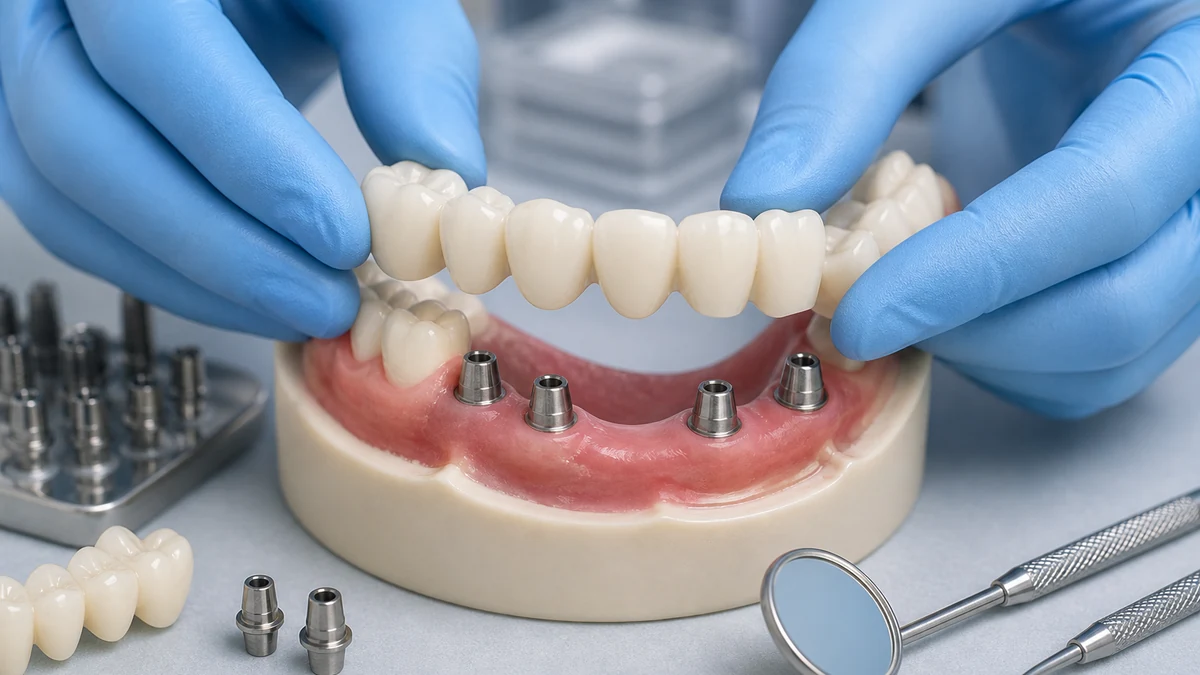
An implant-supported bridge is a fixed restoration that replaces several missing teeth in a row by anchoring to two or more dental implants rather than to your natural teeth. For patients in Turkey and Istanbul exploring tooth replacement, it sits between a single implant and a full-arch solution: ideal when you have a gap of three, four or more adjacent teeth but enough healthy bone to support implants at each end. Unlike a traditional bridge, it does not require grinding down the neighbouring teeth, and unlike a denture, it stays fixed in the mouth. This guide explains how it works, who qualifies, the realistic benefits and risks, and approximate costs.
What is an implant-supported bridge?
It is a series of joined artificial teeth (the bridge) held in place by dental implants placed into the jawbone. The end teeth, called abutments, attach to the implants; the teeth in between, called pontics, fill the gap without needing their own implant. A typical three-to-four-tooth span uses two implants, while longer spans may need three or more for stability. Because the load travels through titanium posts fused to the bone rather than through adjacent natural teeth, the surrounding teeth stay untouched and the bite force is distributed more naturally.
This makes it a strong middle option for people missing several consecutive teeth who do not want a removable partial denture and do not need a complete arch replaced. For larger cases, treatments such as full-arch options like All-on-4 may be more appropriate, and your clinician will help you weigh the choice.
Who is a good candidate for an implant-supported bridge?
Good candidates have several missing teeth in a row, healthy gums, and sufficient jawbone to hold implants at each end of the gap. People in generally good health who do not smoke heavily tend to heal more predictably. Uncontrolled diabetes, active gum disease or significant bone loss may need treatment first.
If you have lost bone where teeth have been missing for a long time, a bone graft may be recommended before implants can be placed. Heavy grinding (bruxism) does not rule you out, but a night guard is often advised to protect the restoration. A consultation with a scan is the only reliable way to confirm suitability, because candidacy depends on bone volume and overall oral health that cannot be judged from photographs alone.
How does the implant-supported bridge procedure work?
The treatment usually unfolds across two stages with a healing period in between. Many international patients complete it over two trips to Turkey, several months apart, or in a single longer stay where the timeline allows.
- Consultation and planning. A 3D scan and examination map your bone, nerves and sinus position so implant placement is planned precisely.
- Implant placement. Under local anaesthetic, the implants are placed into the jaw at each end of the gap. A temporary restoration may be fitted so you are not left without teeth.
- Healing and integration. Over roughly three to six months, the implants fuse with the bone in a process called osseointegration. Timelines vary by patient and jaw.
- Bridge fitting. Once integration is confirmed, abutments are attached and the custom bridge is secured, then checked for fit, bite and appearance.
You can read more about the underlying technology on our guide to dental implants in Turkey, which covers materials, healing and aftercare in greater depth.
What are the benefits of an implant-supported bridge?
The main advantages centre on stability, bone health and preserving your natural teeth. Because the bridge is anchored to implants, it does not slip, and it does not rely on cutting down healthy neighbouring teeth the way a conventional bridge does.
- Fixed and stable: it stays in place for eating and speaking, with no removal for cleaning.
- Protects neighbouring teeth: the adjacent natural teeth are not ground down to act as anchors.
- Helps maintain bone: implants stimulate the jawbone, which can slow the bone loss that follows missing teeth.
- Natural feel and appearance: a well-made bridge restores chewing function and a confident smile.
- Durable: with good oral hygiene and regular check-ups, implant restorations can last 15 years or more.
What are the risks and considerations?
As with any surgery, there are honest trade-offs. Implant placement carries a small risk of infection, swelling, bleeding or, rarely, nerve irritation or sinus involvement in the upper jaw. Most issues are minor and manageable, but no procedure is guaranteed.
The treatment is also a commitment of time and cost: integration takes months, so this is not a same-week fix. Implant failure is uncommon but possible, and smoking, poor hygiene or untreated gum disease raise that risk. Long-term success depends heavily on daily cleaning around the bridge and on attending regular reviews. A reputable clinic will discuss these factors with you openly rather than promising a perfect outcome, and will tailor the plan to your bone, bite and health.
An implant-supported bridge is a long-term investment in fixed, comfortable teeth, so the planning and aftercare matter as much as the surgery itself.
How much does an implant-supported bridge cost in Turkey?
Costs are approximate and vary by case, depending on the number of implants, whether grafting is needed, and the materials chosen. As a general guide, an implant-supported bridge in Turkey often falls in the region of approximately £1,500 to £4,000, compared with roughly £6,000 to £12,000 or more for similar work in the UK. These are evergreen ranges, not a quote, and your individual plan may differ.
Turkey has become a significant destination for dental care largely because lower clinical and living costs make treatment more affordable, while many clinics offer modern equipment and experienced teams. Affordability does not mean lower standards are acceptable, so it is worth comparing this option against a conventional dental bridge in Turkey to understand which suits your case and budget.
Why consider Seren Klinik for tooth replacement?
At Seren Klinik in Istanbul, our specialist team plans each implant-supported bridge around a 3D scan and a full assessment of your bone and bite, rather than a one-size-fits-all template. We talk through candidacy, realistic timelines and aftercare before any treatment begins, so you understand the trade-offs as well as the benefits. International patients receive a tailored plan and clear guidance on the number of visits their case is likely to need.
Related reading
Mahir Yılmaz
Dr. Mahir Yılmaz graduated from Istanbul University Faculty of Dentistry. He has extensive academic knowledge and clinical experience in general and restorative dentistry. With many years of professional experience, Dr. …
View full profile →