
 English
  Turkce
  Deutsch
  Francais
  Russkij
  العربية
  Espanol
  Italiano
  Nederlands
  Balgarski
  Romana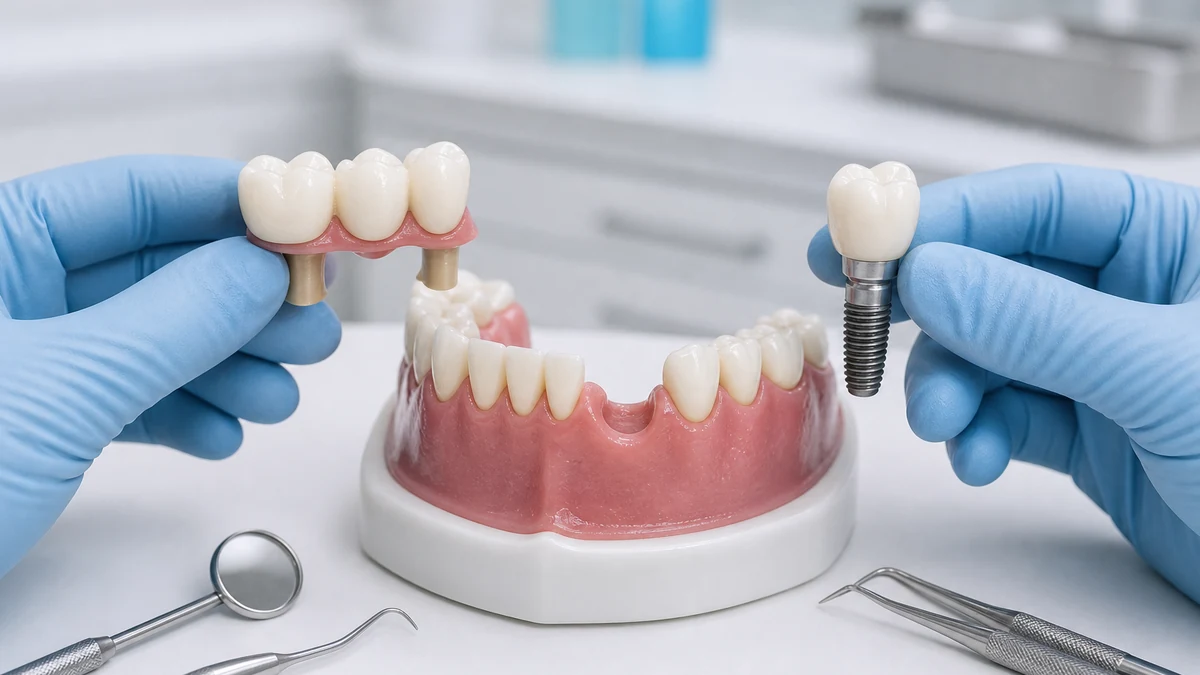
When you lose a tooth, the two leading fixed replacements are a dental bridge and a dental implant. A dental bridge spans the gap by anchoring a false tooth to the teeth on either side, while a dental implant is a small post placed in the jaw to support a single crown. Choosing between a dental bridge and an implant for a missing tooth is one of the most common decisions international patients face when planning treatment in Turkey. This guide compares the two options honestly on cost, longevity, bone health, recovery and suitability, so you can decide which is better for your case with your dentist in Istanbul.
Dental bridge vs implant: side-by-side comparison
The table below summarises the key practical differences for a single missing tooth. Your bone quality, gum health and the condition of the neighbouring teeth all affect which option is right, so treat this as a starting point rather than a verdict.
| Factor | Dental bridge | Dental implant |
|---|---|---|
| What it is | False tooth fixed to the adjacent teeth | Titanium or ceramic post in the jaw with a crown |
| Surgery | None for a traditional bridge | Minor surgical placement required |
| Effect on neighbours | Adjacent teeth are reshaped and crowned | Neighbouring teeth left untouched |
| Jawbone | Does not replace the root; bone can shrink | Replaces the root and helps preserve bone |
| Treatment time | Usually two visits over about two weeks | Several months including healing |
| Typical lifespan | Around 10 to 15 years | Often 15+ years with good care |
| Upfront cost | Generally lower | Generally higher |
What is a dental bridge?
A dental bridge replaces a missing tooth by using the natural teeth on each side of the gap as anchors. Those supporting teeth are reshaped and capped with crowns, and a false tooth, called a pontic, is fixed between them. Once cemented, the bridge is not removable by the patient and feels far more stable than a denture.
The most common design is the traditional bridge, though Maryland and cantilever versions exist for specific situations. If you want the full picture of the designs available, our overview of the four types of dental bridge explains when each is used.
What is a dental implant?
A dental implant is a small screw-shaped post, usually titanium, that is placed into the jawbone to act as an artificial tooth root. Over a few months the bone fuses to the post through a process called osseointegration, creating a stable foundation. A crown is then attached on top to complete the tooth.
Because the implant stands alone, the neighbouring teeth are left fully intact. For a closer look at how the procedure works for one tooth, see our guide to the single tooth implant in detail.
Which lasts longer, a bridge or an implant?
Implants tend to last longer. With good oral hygiene and regular check-ups many implants serve well for over fifteen years, while a typical bridge often lasts ten to fifteen years before it needs replacing. Longevity depends on cleaning, bite and overall health.
A bridge can shorten the life of the supporting teeth if they decay under the crowns, and the area beneath the pontic must be cleaned carefully with a floss threader or interdental brush. An implant is cleaned much like a natural tooth, although the gum around it still needs daily attention to prevent inflammation. No restoration lasts for ever, and smoking, uncontrolled diabetes and poor hygiene shorten the lifespan of either option.
Does a missing tooth cause bone loss?
Yes, over time. When a tooth is lost the jawbone beneath the gap is no longer stimulated by chewing and can gradually shrink. A dental implant replaces the root and helps preserve the bone, whereas a conventional bridge sits above the gum and does not.
This is one of the clearest long-term differences between the two. Over many years, bone loss under a bridge can change the way the gum sits and occasionally affect the appearance of the smile. For patients who already have reduced bone, an implant may require a graft first, which your dentist will assess from an X-ray or scan.
Is a bridge or an implant cheaper?
A bridge usually costs less upfront. In Turkey a traditional three-unit bridge sits in a broad range of roughly 400 to 900 pounds, while a single implant with crown is typically higher. These figures are approximate and vary by case. An implant may prove better value long term.
The reason is partly that an implant treats only the missing tooth, whereas a three-unit bridge involves crowning two healthy neighbours as well. The table below gives approximate, evergreen ranges for a single missing tooth.
| Option | UK approx. | Turkey approx. |
|---|---|---|
| Traditional bridge (3-unit) | £900–£2,500 | £400–£900 |
| Single implant with crown | £2,000–£3,000 | £500–£1,200 |
Turkey is consistently more affordable than the UK or the United States for both treatments, mainly because of lower clinic running costs and a strong dental-tourism sector, not because of any drop in standards. The figures above are approximate ranges and vary by case; a clinic can only confirm a price after an in-person or photo assessment, and the wider cost of dental implants in Turkey depends on the materials and number of teeth involved.
For a single missing tooth with healthy neighbours, many dentists view an implant as the most conservative long-term choice, because it leaves the surrounding teeth untouched and helps protect the bone.
Can I get a bridge if I do not want implant surgery?
Yes. A traditional bridge needs no surgery and is a common choice for patients who prefer to avoid an implant operation, who have a shorter timeline, or whose budget or bone makes surgery less suitable. Your dentist will confirm that the supporting teeth are strong enough.
A bridge can often be completed within a single trip to Istanbul, which appeals to travelling patients on a tight schedule. The trade-off is that otherwise healthy teeth are permanently reshaped to carry the crowns, a step that cannot be reversed.
Considerations and risks of each option
Both treatments are well established and complications are uncommon, but neither is risk-free. With a bridge, the main concerns are decay or nerve problems in the reshaped supporting teeth, difficulty cleaning under the pontic, and gradual bone loss beneath the gap. Because the bridge depends on its neighbours, a problem with one anchor tooth can affect the whole restoration.
With an implant, possible issues include infection around the post (peri-implantitis), the implant failing to fuse with the bone, and the need for a bone graft if support is insufficient. Healing also takes several months. A thorough assessment, an honest review of your medical history and diligent aftercare are the best ways to reduce these risks with either choice.
Is a dental implant better than a bridge?
Neither is universally better. An implant replaces the tooth root, preserves jawbone and spares the neighbouring teeth, but needs surgery and healing time. A bridge is faster and avoids surgery but relies on reshaping adjacent teeth. The right choice depends on your case.
As a practical guide, an implant is often preferred when the teeth either side of the gap are healthy and untouched, when you want the longest-lasting result, and when preserving bone matters to you. A bridge tends to suit patients who want to avoid surgery, who need a faster result, who have a tighter budget, or whose adjacent teeth already need crowns anyway. Where bone is limited, an implant may still be possible with grafting, while a bridge offers a non-surgical route. Only an in-person or radiographic assessment can confirm which option is right, and our specialist team will recommend the approach that protects your long-term oral health rather than a one-size-fits-all answer.

Parvin Safaraliyev
Dr. Parvin Safaraliyev graduated from Istanbul University Faculty of Dentistry. She specializes in oral and maxillofacial surgery, combining advanced surgical techniques with comprehensive patient care. She integrates th…
View full profile →