
 English
 Turkce
 Deutsch
 Francais
 Russkij
 العربية
 Espanol
 Italiano
 Nederlands
 Balgarski
 Romana
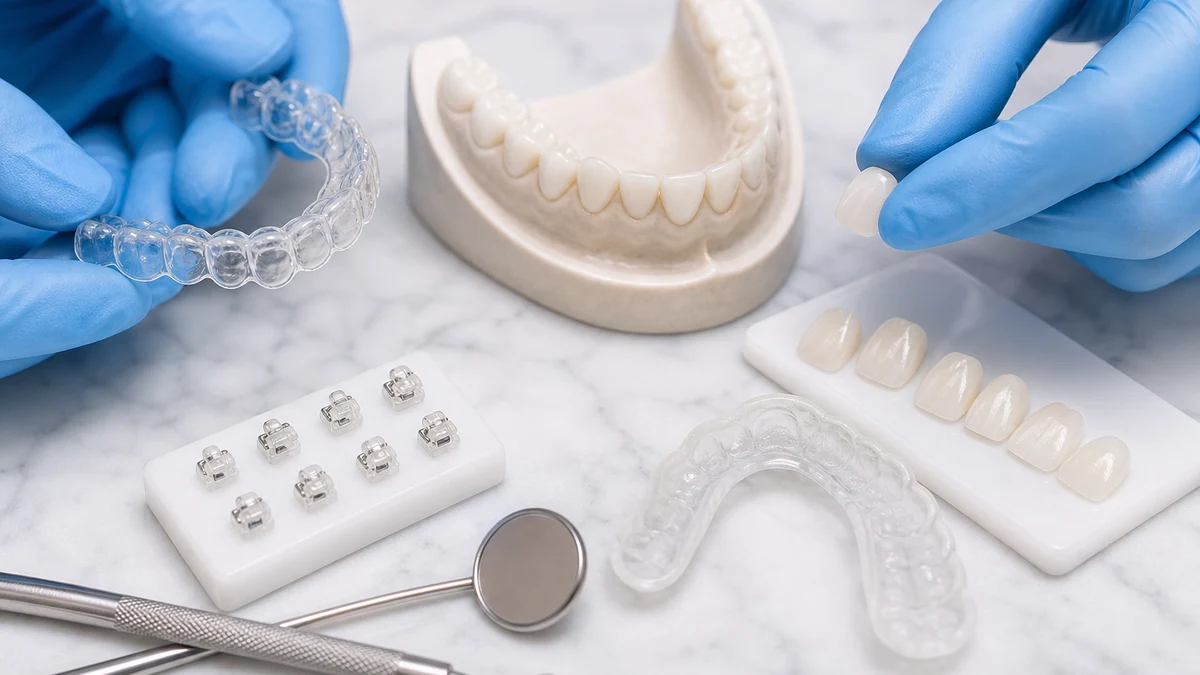
Yes, you can combine orthodontics with veneers or whitening, and many smile plans deliberately do. Orthodontics in Turkey, whether braces or clear aligners, moves your teeth into a healthier, straighter position, while veneers and teeth whitening change how the teeth look. The two approaches solve different problems, so pairing them can produce a result neither achieves alone. What matters most is the order: as a general rule teeth are straightened first, then refined or brightened afterwards. This guide explains how international patients can plan a combined orthodontic and cosmetic treatment, the sensible sequence, realistic timings and the points to discuss with a dentist before you start.
Why combine orthodontics with cosmetic dentistry?
Orthodontics and cosmetic dentistry answer different questions. Braces and aligners correct the position of teeth, closing gaps, fixing crowding and improving how the bite meets. Veneers, bonding and whitening address colour, shape and surface, masking discolouration or reshaping worn or uneven edges. When teeth are both misaligned and discoloured or chipped, doing one without the other often leaves the smile half-finished.
Combining the two can also be more conservative. If crooked teeth are straightened first, the cosmetic work that follows is usually simpler, because the dentist is enhancing teeth that are already well positioned rather than disguising a poor one. In some cases, good orthodontics reduces how much veneer or bonding you need at all, since alignment alone can resolve part of the concern. The goal is a balanced plan that uses each treatment for what it does best.
In what order should you do orthodontics, veneers and whitening?
In most cases the order is orthodontics first, then whitening, then veneers or bonding last. Straightening teeth before any cosmetic work means the position is settled, the dentist can plan colour and shape accurately, and you avoid placing permanent restorations on teeth that may still move.
There is sound reasoning behind this sequence. Moving a tooth that already carries a veneer or crown is more complicated, because aligner and bracket systems are designed to grip natural enamel, and restorations can affect how predictably a tooth shifts. Whitening is generally done after orthodontics but before veneers, so your natural teeth reach their target shade first; the veneers can then be matched to that brighter colour, since porcelain itself does not respond to whitening gel. Bonding and veneers come last, as the finishing layer applied to teeth that are now in their final position and shade. A typical combined plan therefore looks like this:
- Full assessment, including X-rays and digital scans, to map the bite, alignment and tooth condition.
- Orthodontic treatment with braces or aligners to straighten the teeth and correct the bite.
- A short settling period, then professional whitening once alignment is stable.
- Veneers, crowns or composite bonding to refine shape, edges and any remaining colour concerns.
- Retainers to hold the corrected position and protect the investment long term.
Can you whiten teeth after braces or aligners?
Yes, and it is often the ideal moment. Once braces come off or aligner treatment finishes, the teeth are straight and fully accessible, so whitening gel can reach every surface evenly. Many patients wait a couple of weeks for the teeth to settle and any sensitivity to ease, then whiten before considering veneers.
Whitening after orthodontics has practical advantages. With brackets and wires gone, there are no patches left shielded from the gel, which can sometimes happen with fixed braces and lead to uneven shade. Clear aligners do not cause this problem in the same way, but most clinicians still prefer to whiten once active treatment is complete. It is worth knowing that whitening only lightens natural tooth structure, not existing fillings, crowns or veneers, so the timing also helps a dentist decide whether any old restorations will need replacing to match your new shade. If you have a history of sensitivity, a gentler protocol with a lower-strength gel or shorter sessions can usually be arranged, so discomfort is not a reason to avoid whitening after orthodontics.
Do you still need orthodontics if you are having veneers?
Not always, but often it is the healthier choice. Veneers can visually disguise mild crowding or small gaps, which is why some patients are offered veneers alone. For more significant misalignment, however, straightening the teeth first is usually more conservative and protects more of your natural tooth.
The concern with using veneers to mask crooked teeth is how much enamel may need to be removed to make poorly positioned teeth look straight. The more a tooth is reduced, the more committed you are to restorations for life, since enamel does not grow back. Orthodontics moves the tooth itself, so the veneer that follows can be thinner and require less preparation, or may not be needed at all. This is the difference between correcting the foundation and covering it over. For many international patients, a short course of clear aligners such as Invisalign in Turkey before any cosmetic work means the final dental veneers are kept to a minimum, which is generally better for the long-term health of the teeth. A qualified dentist should walk you honestly through both routes, including where veneers alone are reasonable and where they are not.
How long does a combined treatment take?
It depends mainly on the orthodontic stage. Aligners or braces commonly take several months to around two years, depending on how much movement is needed. Whitening and veneers are quick by comparison, usually completed within a few weeks once the teeth are straight, so orthodontics sets the overall timeline.
For international patients this has clear planning implications. The orthodontic phase generally cannot be rushed and is often managed partly from home, with periodic reviews or remote monitoring, then the cosmetic finishing visits are scheduled together at the end. Some patients choose lighter orthodontic correction to shorten the timeline, accepting that the cosmetic stage will then do a little more of the work. This is exactly the kind of trade-off a combined plan should make explicit. Bringing several treatments under one coordinated plan, as set out in our overview of a smile makeover in Turkey, helps keep the sequence, the number of trips and the total cost predictable rather than improvised.
What does a combined smile treatment cost?
Costs vary widely because every plan is different, but combined treatment in Turkey is typically far more affordable than equivalent care in the UK. As an approximate guide, clear-aligner or brace treatment often runs into the lower thousands of pounds, professional whitening into the low hundreds, and veneers are priced per tooth, so the total depends heavily on how many you need.
These figures are approximate and vary by case, by clinic and by how many teeth are treated, so they should be read as ranges rather than quotations. A plan involving light orthodontics, whitening and a handful of veneers will cost considerably less than full-arch alignment followed by a large set of veneers. When comparing prices, check what each quote includes, such as scans, retainers, whitening top-ups and follow-up visits, as these affect the real total. Turkey tends to be significantly cheaper than the UK or US for this kind of work, without that necessarily meaning lower quality, but the right comparison is always like for like: the same treatments, the same materials and a clinician you trust.
Frequently asked questions
Should I get braces or veneers first?
Braces or aligners almost always come first. Straightening the teeth settles their position, so any veneers placed afterwards can be thinner and better planned. Placing veneers before orthodontics is generally avoided, because moving a restored tooth is more complex and less predictable than moving natural enamel.
Can you whiten teeth after braces or Invisalign?
Yes. Whitening after orthodontics is common and often ideal, because the straightened teeth are fully accessible and the gel reaches every surface evenly. Most clinicians suggest waiting a couple of weeks for the teeth to settle, then whitening before any veneers, since porcelain does not change colour with whitening.
Do veneers replace the need for orthodontics?
Sometimes, but not always. Veneers can disguise mild crowding or small gaps, yet for noticeable misalignment, straightening the teeth first is usually more conservative and removes less natural tooth. A dentist should explain honestly when veneers alone are reasonable and when orthodontics is the healthier route.

Mahir Yılmaz
Dr. Mahir Yılmaz graduated from Istanbul University Faculty of Dentistry. He has extensive academic knowledge and clinical experience in general and restorative dentistry. With many years of professional experience, Dr. …
View full profile →