
 English
  Turkce
  Deutsch
  Francais
  Russkij
  العربية
  Espanol
  Italiano
  Nederlands
  Balgarski
  Romana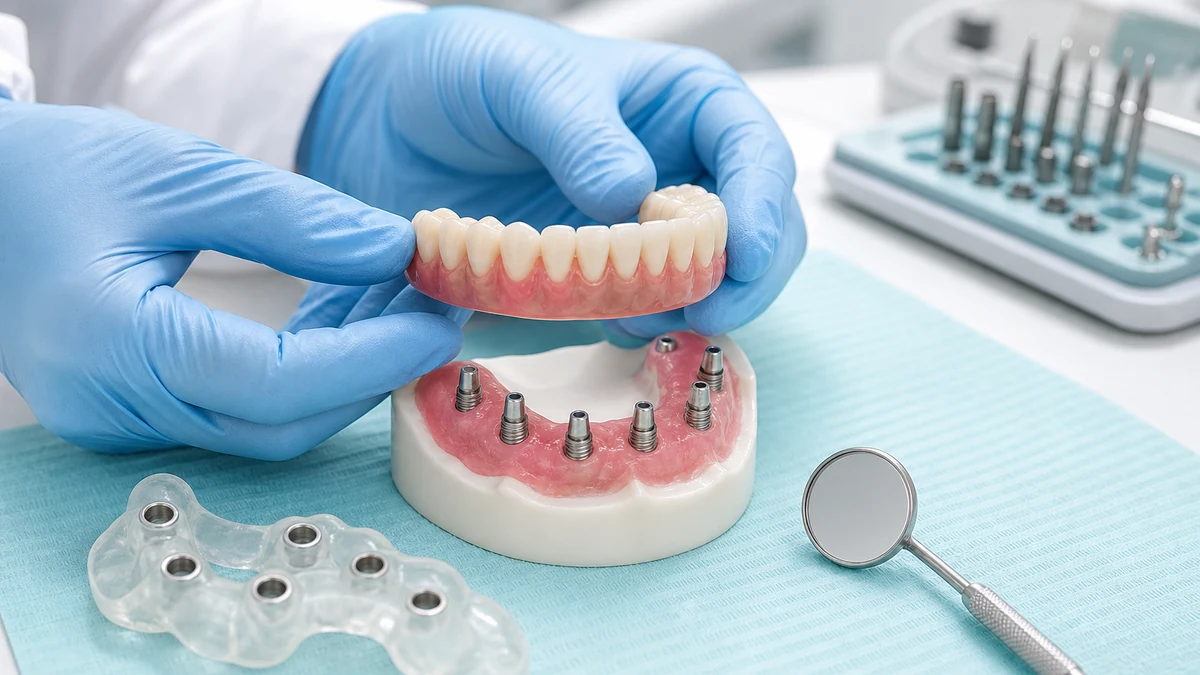
All-on-6 dental implants in Turkey are a full-arch restoration that anchors a complete set of fixed teeth onto six titanium implants placed in a single jaw. The technique restores an entire upper or lower arch without a denture that lifts or slips. People often weigh All-on-6 against the four-implant version when a surgeon advises that more support would spread chewing forces more evenly. Istanbul has become a leading destination for this treatment because experienced oral surgery teams combine the full workflow, planning, surgery, and a fixed bridge, at a fraction of UK or US pricing.
What are All-on-6 dental implants?
All-on-6 is a fixed full-arch solution that uses six dental implants per jaw to carry a permanent bridge of replacement teeth. The two extra implants, compared with a four-implant design, add anchorage points and can distribute biting load across more of the jawbone.
The bridge itself is screwed onto the implants, so it does not come out for cleaning the way a removable denture does. For patients who have lost most or all of their teeth in an arch, this offers a stable, natural-feeling set of teeth that stays in place when eating and speaking. The materials are usually acrylic on a titanium frame, or a more durable zirconia bridge, depending on the case and budget.
Who needs All-on-6 instead of fewer implants?
All-on-6 suits people who have enough jawbone to hold six implants and who would benefit from extra support across the arch, often those restoring the upper jaw, where bone tends to be softer. Your surgeon decides based on a CT scan, bone density, and bite forces.
Good candidates typically share a few features:
- Significant tooth loss across a full arch, or failing teeth that cannot be saved.
- Adequate bone volume in six planned implant sites, confirmed on a 3D scan.
- A heavier bite or a preference for a more rigid, longer bridge with fewer cantilevered (unsupported) sections.
- General good health, with conditions such as diabetes well managed before surgery.
Heavy smoking, uncontrolled gum disease, and certain medications can lower success rates, so an honest medical history matters. If bone is limited, a surgeon may suggest grafting, a different implant angle, or the four-implant approach instead. Many patients researching this also compare it directly with the four-implant All-on-4 technique to understand which design fits their anatomy.
How does the All-on-6 procedure work?
The All-on-6 procedure usually runs across two visits to Turkey: surgery with a temporary bridge first, then the final bridge after healing. Most of the process is planned digitally before you arrive, which keeps the in-clinic time efficient for international patients.
A typical pathway looks like this:
- Consultation and 3D imaging. A CT scan maps bone and nerve positions so implant sites are planned precisely.
- Surgery. Under local anaesthetic, often with sedation, any remaining hopeless teeth are removed and six implants are placed in one arch.
- Temporary bridge. A provisional fixed bridge is fitted, frequently on the same day or within a few days, so you leave with teeth.
- Healing (osseointegration). Over roughly three to six months the implants fuse with the bone.
- Final bridge. On a second trip, the permanent bridge is fitted and the bite is adjusted.
Healing times vary by individual and by jaw, and your surgical team will give you a schedule based on your scans rather than a fixed promise.
What are the benefits and the risks?
The main benefit is a fixed, full set of teeth on a well-supported framework, restoring chewing and confidence without a removable plate. The honest trade-off is that this is real oral surgery, so it carries the normal surgical risks and demands disciplined aftercare.
On the benefit side, patients commonly report stable chewing, clearer speech, and a bridge that can last many years with good maintenance. Spreading the load over six implants may also reduce stress on each individual post.
On the risk side, you should know that:
- Implant failure can happen, though modern implants have high long-term success rates when placed and cared for well.
- Infection, swelling, and bruising are normal short-term effects that your team will help you manage.
- Smoking and poor cleaning are the most common reasons implants struggle over time.
- The bridge may need adjustment or a future component replacement, so this is a long-term relationship with your dental care.
A full-arch restoration only succeeds when surgery and aftercare work together; the implants do the holding, but daily cleaning and regular reviews protect them for the long run.
How much do All-on-6 implants cost in Turkey?
All-on-6 in Turkey is typically a fraction of UK or US pricing, with costs that vary by materials, the number of extractions, and whether grafting is needed. The figures below are approximate ranges per arch and vary case by case, so treat them as a guide rather than a quote.
| Location | Approx. cost per arch (GBP) | Approx. cost per arch (USD) | Approx. cost per arch (EUR) |
|---|---|---|---|
| Turkey | £4,000–£8,000 | $5,000–$10,000 | €4,700–€9,400 |
| United Kingdom | £12,000–£20,000 | $15,000–$25,000 | €14,000–€23,500 |
| United States | £16,000–£24,000 | $20,000–$30,000 | €19,000–€28,000 |
The Turkish price usually reflects lower clinic running costs and a strong concentration of full-arch surgical experience, not lower standards. A zirconia bridge sits at the higher end of the range, while an acrylic bridge on a titanium bar is more affordable. You can compare the wider category in our guide to dental implants in Turkey, which covers single implants through to full-arch options.
Why do patients choose Turkey for full-arch implants?
Patients choose Turkey for the combination of cost savings, high case volumes, and full treatment packages that bundle surgery, the bridge, and often accommodation. Istanbul clinics handle large numbers of international full-arch cases each year, which builds practical surgical experience.
For a major procedure like this, it is worth checking a clinic's surgeon credentials, asking who places the implants, and confirming the aftercare and warranty arrangements before you travel. A measured, well-planned approach protects a result you will rely on for years. If you are also restoring a few individual teeth rather than a whole arch, our overview of single dental implants in Turkey explains how those cases differ.
Frequently asked questions
Is All-on-6 better than All-on-4?
Neither is universally better; the right choice depends on your bone and bite. All-on-6 adds two anchorage points and can suit softer bone or heavier bites, while All-on-4 may be enough when bone is limited. Your surgeon decides from your 3D scan.
How long do All-on-6 implants last?
With good cleaning and regular check-ups, the implants themselves can last many years, and studies suggest high long-term success rates. The bridge fitted on top may need maintenance or eventual replacement, so think of it as a long-term restoration rather than a permanent fixture.
Is the All-on-6 procedure painful?
Surgery is carried out under local anaesthetic, often with sedation, so you should not feel pain during placement. Some swelling and discomfort for a few days afterwards is normal and is usually managed well with prescribed medication and your team's aftercare guidance.
Related reading
Mahir Yılmaz
Dr. Mahir Yılmaz graduated from Istanbul University Faculty of Dentistry. He has extensive academic knowledge and clinical experience in general and restorative dentistry. With many years of professional experience, Dr. …
View full profile →