
 English
  Turkce
  Deutsch
  Francais
  Russkij
  العربية
  Espanol
  Italiano
  Nederlands
  Balgarski
  Romana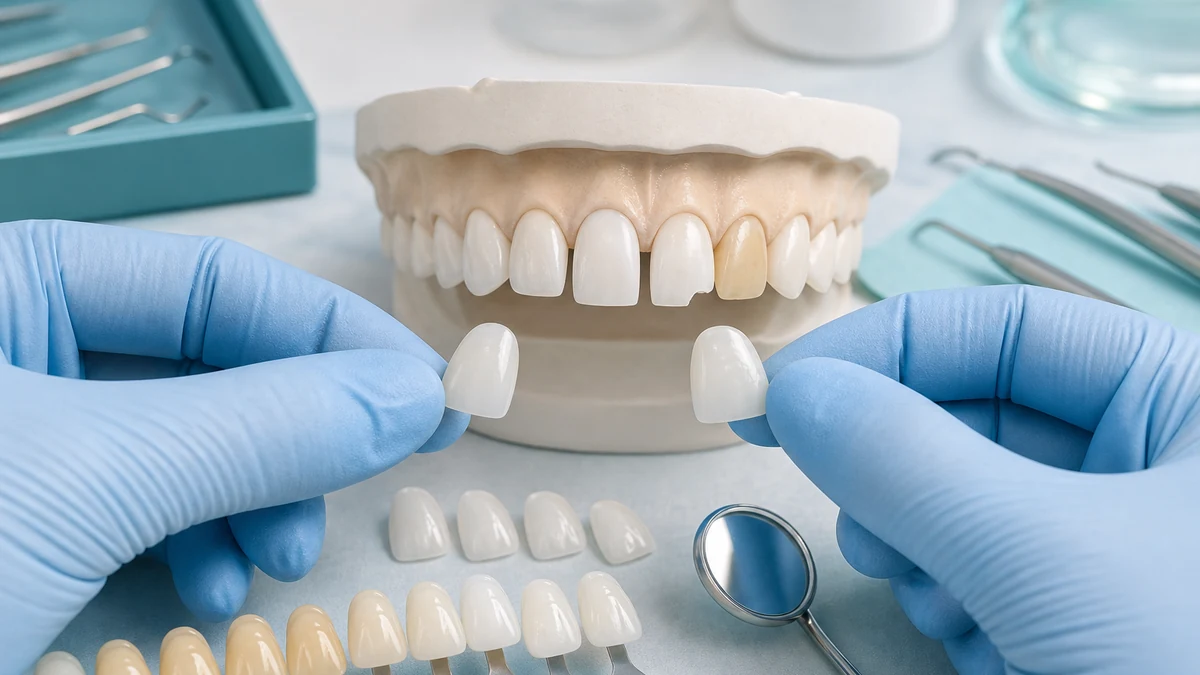
Dental veneers are thin, custom-made shells of porcelain or composite resin bonded to the front of your teeth to change their colour, shape and position. For international patients researching veneers in Turkey, the common question is a practical one: what do veneers actually fix? In short, veneers are a cosmetic solution that reliably addresses three problems at once, gaps between teeth, chipped or worn edges, and stubborn discoloration that whitening cannot shift. This guide explains what they correct, where their limits lie, who suits them and roughly what they cost, so you can judge whether veneers fit your case before you book a consultation.
What veneers are and how they work
A veneer covers the visible front surface of a tooth, leaving the back and biting edges largely as they are. Porcelain veneers are made in a laboratory and bonded in place; composite veneers are sculpted directly onto the tooth in a single visit. Because each veneer is shaped and shaded individually, a set can be designed to sit evenly, match a chosen tooth colour and create a uniform, natural-looking smile line. Veneers change how teeth look, not how the underlying bite functions, which is why they are classed as cosmetic rather than restorative dentistry.
What do veneers fix?
Veneers correct cosmetic flaws in the front teeth: small gaps, chips and cracks in the enamel, worn or uneven edges, mild crowding or rotation, slightly undersized teeth, and deep discoloration that does not respond to whitening. A set of veneers can address several of these at the same time, which is why they are popular for a full smile refresh rather than a single isolated repair.
They are best understood as a resurfacing treatment. By masking the natural tooth and rebuilding its outline, veneers improve symmetry, proportion and colour together. What they do not do is move teeth through the jaw, treat decay or gum disease, or change the way your teeth meet when you bite.
Closing gaps between teeth
A small gap, often between the two upper front teeth, can be closed by making the adjacent veneers slightly wider so they meet in the middle. This is a quick cosmetic fix for a narrow space. A wide gap, or several gaps caused by genuine misalignment, is usually better treated with orthodontics first, because forcing the look with oversized veneers can leave teeth bulky or unnatural.
Repairing chips and worn edges
Chipped corners, hairline cracks in the enamel and edges flattened by years of wear can all be rebuilt with a veneer that restores the original shape. For a single small chip, composite bonding is often enough and more conservative. Where several front teeth are chipped or worn together, a matched set of veneers gives a more consistent and durable result.
Masking discoloration whitening cannot remove
Some stains sit deep within the tooth and do not lighten with bleaching: tetracycline staining, fluorosis, the grey cast of an old root-treated tooth, or simple age-related darkening. Because a veneer covers the front of the tooth with a new, controlled shade, it can mask this kind of intrinsic discoloration. If your teeth are simply yellowed by surface stains, professional whitening is the cheaper first step, but for stains that whitening will not shift, veneers are a dependable option.
Who is a good candidate for veneers?
Veneers suit people whose teeth are basically healthy but cosmetically flawed: sound enamel, no untreated decay, and healthy gums. The ideal candidate wants to improve colour, small gaps, chips or shape across the front teeth, and understands that most porcelain veneers involve removing a thin layer of enamel, which makes them a long-term commitment to that tooth.
Some situations need treatment before veneers, or a different approach altogether. Active gum disease or decay must be resolved first. People who grind or clench their teeth are at higher risk of chipping a veneer and may need a nightguard or another material. Significant crowding or a misaligned bite is usually better corrected with orthodontics, and a badly broken or root-treated tooth often needs a crown rather than a veneer for proper protection.
How long do veneers last, and what are the trade-offs?
Porcelain veneers commonly last around 10 to 15 years, and often longer with good care, while composite veneers tend to last a shorter time and may need refreshing or polishing sooner. Lifespan depends on your bite, oral hygiene and habits, and no veneer is permanent: each will eventually need replacing.
The honest trade-offs matter. Where enamel is removed, the change is irreversible and the tooth will always need some form of covering. Veneered teeth can be more sensitive for a short period afterwards, and a veneer can chip or debond and require repair. Veneers also do not whiten over time, so the shade you choose is the shade you keep. None of this rules veneers out, but it is why a careful consultation, with an honest assessment of whether a simpler option would do, is the sensible first step.
Veneers are a resurfacing treatment, not a structural one: they are excellent at improving how front teeth look, but they do not move teeth, treat disease or fix the bite.
How much do veneers cost?
Costs are approximate and vary by case, by material and by how many teeth are treated. As a rough guide, porcelain veneers typically run from a few hundred pounds per tooth upwards, while composite veneers usually sit at the lower end of that range. A full upper set of six to eight veneers is therefore a meaningful investment wherever it is done.
Treatment in Turkey is generally significantly more affordable than equivalent work in the UK or US, which is a large part of why international patients travel for it, though price should never be the only factor. When you are weighing options it helps to compare materials directly, since the choice between porcelain versus composite veneers affects both the cost and the lifespan of the result. For a full picture of process, materials and aftercare, see our guide to dental veneers in Turkey.
When veneers are not the right answer
Veneers are not a cure-all. If your main concern is general yellowing, whitening is cheaper and less invasive. If teeth are noticeably crooked, orthodontics gives a healthier long-term result. If a tooth is heavily broken down or root-treated, a crown protects it better. And if discoloration is the issue but the cause is deeper than surface staining, it is worth understanding the full set of options for discolored teeth that whitening will not fix before committing. A good clinician will tell you when a simpler or more conservative treatment would serve you better.
Related reading

Mehmet Şimşek
Dentist Mehmet Şimşek graduated from Istanbul University Faculty of Dentistry. He applies treatment methods aimed at creating natural and healthy smiles. He continues his work in implantology, prosthetic dental treatment…
View full profile →