
 English
  Turkce
  Deutsch
  Francais
  Russkij
  العربية
  Espanol
  Italiano
  Nederlands
  Balgarski
  Romana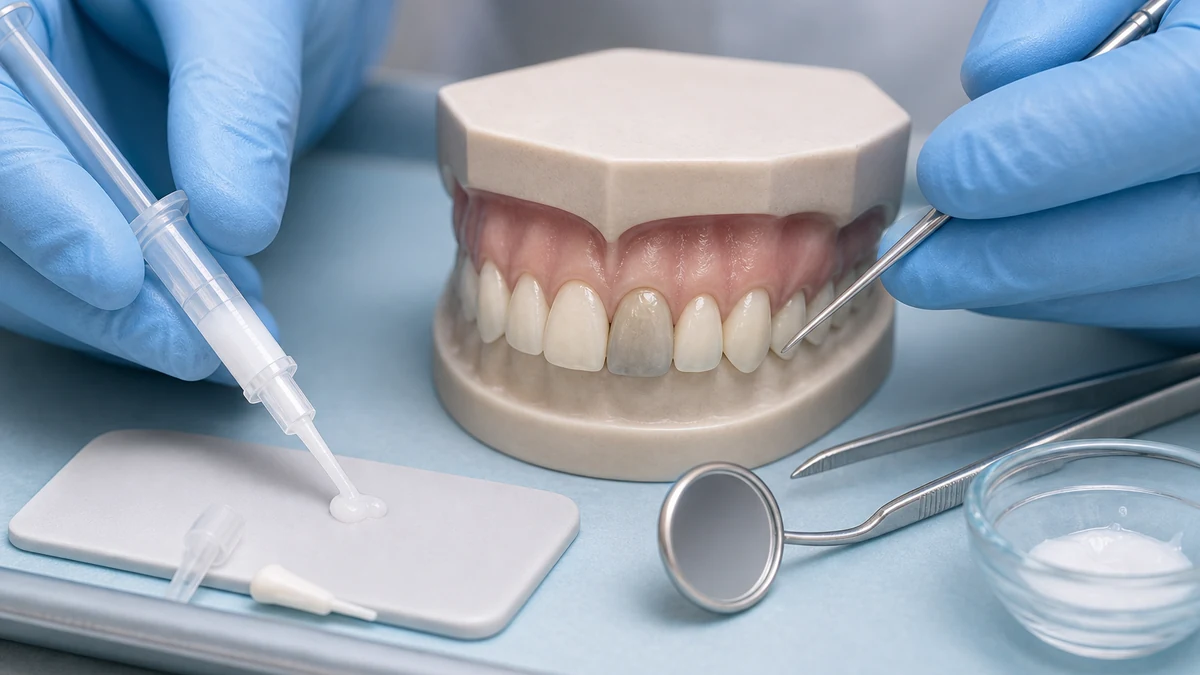
Internal bleaching is a dental procedure that whitens a single dark, non-vital (dead) tooth from the inside, rather than treating the outer surface the way standard whitening does. Also called non-vital or walking bleach, it is used when one tooth has turned grey, brown, or yellow after the nerve inside it has died, usually following trauma or root canal treatment. Because a discoloured front tooth stands out far more than a generally dull smile, internal bleaching is a targeted, tooth-conserving way to even out your colour without drilling away healthy enamel. It is a useful option to understand alongside conventional teeth whitening in Turkey, which works very differently.
Why does a single tooth go dark?
A single tooth usually goes dark because its inner pulp, the soft tissue holding the nerve and blood vessels, has died. As the pulp breaks down, blood pigments seep into the surrounding dentine and stain the tooth from within, so the discolouration comes from inside rather than the surface.
This is why external whitening, which lifts surface and enamel stains, often fails to shift a dead tooth: the problem sits deeper than any surface gel can reach. Common reasons a tooth loses its vitality include:
- A knock or fall that damages the blood supply, sometimes years before the colour changes.
- A deep cavity that reaches the pulp and causes infection.
- Previous root canal treatment, especially where old filling material has darkened over time.
- Internal bleeding within the tooth after an injury, which leaves a grey or pink tinge.
Vital versus non-vital discolouration
It is worth separating the two. A vital tooth (one with a living nerve) that looks dull responds well to standard whitening. A non-vital tooth has no living pulp and is the candidate for internal bleaching. Your dentist confirms which you have with vitality tests and an x-ray before recommending any treatment.
How does internal bleaching work?
Internal bleaching works by placing a whitening agent inside the tooth, in the hollow chamber left after root canal treatment, so it bleaches the stained dentine outward. The tooth is sealed with a temporary filling between visits, which is why the technique is often called the walking bleach method.
The tooth must already have a completed, healthy root canal, because the chamber needs to be accessible and sealed at the root end to keep the bleaching agent away from the surrounding bone. The general sequence is as follows:
- Your dentist checks the existing root canal on an x-ray and confirms it is sound, retreating it first if needed.
- A small opening is made at the back of the tooth to reach the pulp chamber.
- A protective barrier is placed over the root filling to seal it off.
- A whitening paste, often sodium perborate or a peroxide gel, is sealed inside with a temporary filling.
- The paste is left to work for several days, then replaced at follow-up visits until the desired shade is reached.
- Once the colour matches, the chamber is cleaned and closed with a permanent tooth-coloured filling.
Most cases need two or three applications, so the treatment is spread across a small number of short appointments rather than completed in a single sitting.
Who is a good candidate for internal bleaching?
A good candidate is someone with a single discoloured tooth that has had successful root canal treatment, sound surrounding gum and bone, and a tooth structure strong enough not to need a crown. It suits front teeth where colour matters most and where the natural tooth is largely intact.
Internal bleaching is less suitable, or not the right first choice, when the tooth is heavily broken down, already cracked, or carries a large old filling, because in those situations a restoration that also rebuilds strength may make more sense. It also cannot be used on a living tooth. Your dentist weighs the condition of the root filling, the amount of healthy tooth remaining, and the depth of the stain before advising whether bleaching alone will give a stable, natural-looking result.
When veneers or crowns suit better
If a dead tooth is also weak, chipped, or has a discolouration too deep to lift fully, covering it can be the more predictable route. A crown or veneer masks the colour and reinforces the tooth in one step. Many patients who research a stubborn stain end up comparing bleaching with cover options, which is why it helps to read about what actually causes teeth to change colour before deciding.
How long does internal bleaching last?
Internal bleaching results can last several years, and often longer, but some gradual fading or partial relapse of the colour is normal over time. A degree of regression is expected, so dentists sometimes bleach slightly past the target shade to allow for it.
Longevity varies from person to person and depends on the original cause of the discolouration, how deep the staining was, and the quality of the final seal. Some teeth hold their new shade well for many years, while others may need a single top-up application later on. This is realistic, achievable whitening rather than a permanent guarantee, and your dentist will give you an honest sense of what your particular tooth is likely to do.
What are the risks of internal bleaching?
The main risk historically linked to internal bleaching is external cervical resorption, a rare condition where the tooth structure breaks down near the gum line. The risk is reduced by sealing the root filling properly and avoiding aggressive, heat-activated techniques.
Because of this, careful case selection and a protective barrier over the root filling are essential, and modern protocols favour gentler agents left to work slowly rather than older high-strength methods. Other points to discuss with your dentist include the chance that the tooth does not lighten enough and needs a veneer or crown instead, temporary sensitivity, and the importance of follow-up to confirm the tooth stays healthy. An honest conversation about these trade-offs is part of good, balanced care, and a well-planned case keeps serious complications uncommon.
Internal bleaching is one of the few ways to brighten a dead tooth without cutting into healthy enamel, which is exactly why conserving tooth structure makes it so appealing when the case is suitable.
Can internal and external whitening be combined?
Yes. Internal and external whitening are sometimes used together, an approach called inside-outside bleaching, when a dead tooth needs both its inner stain lifted and its surface brightened to blend with neighbouring teeth. Your dentist decides whether one method or both will give the most even result.
This combined technique can be helpful where a single dark tooth sits among teeth that would also benefit from a lighter shade, so the whole smile matches rather than leaving one tooth noticeably different. If you are considering whitening your other teeth at the same time, it is worth understanding how surface whitening differs and whether it is right for you, including for those with teeth that tend to be sensitive. As always, the safest plan starts with an examination, an x-ray, and advice from a specialist who can confirm the tooth is healthy before any bleaching begins.
Related reading

Mehmet Kaplan
Dr. Mehmet Kaplan graduated from Istanbul University Faculty of Dentistry. Applying modern dental techniques and up-to-date treatment methods, Dr. Kaplan personalizes his treatments according to the individual needs of h…
View full profile →