
 English
 Turkce
 Deutsch
 Francais
 Russkij
 العربية
 Espanol
 Italiano
 Nederlands
 Balgarski
 Romana
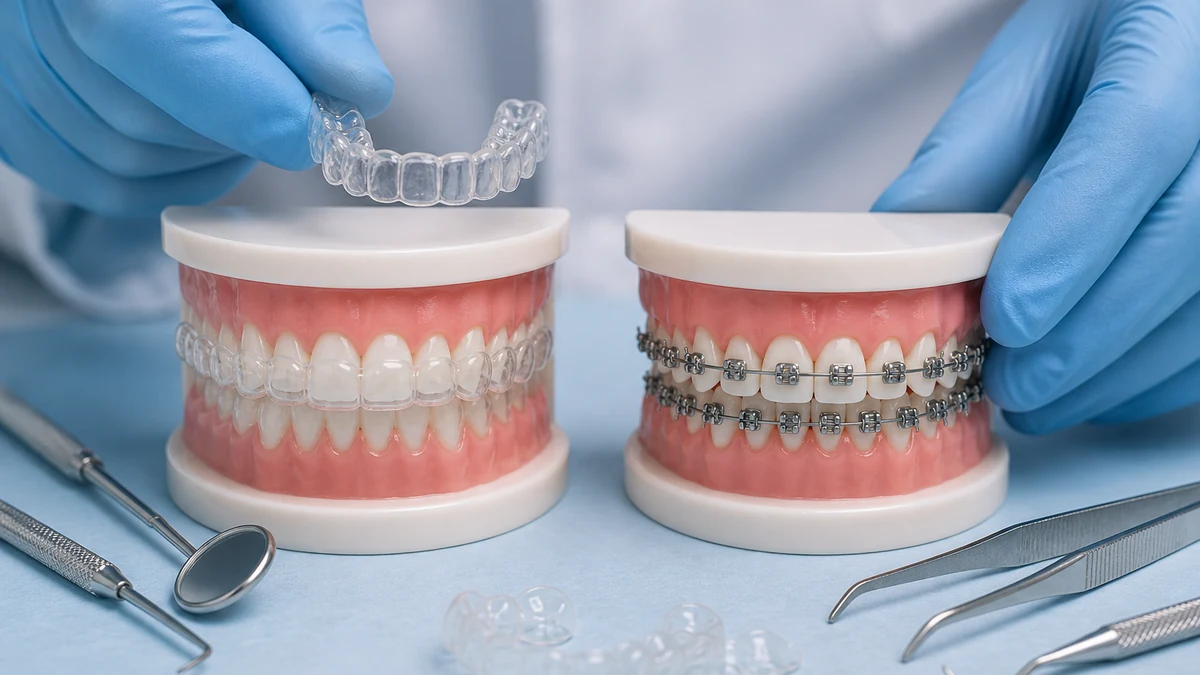
Invisalign versus traditional braces is one of the first decisions most adults face when they decide to straighten their teeth. Invisalign is a clear aligner system that moves teeth using a series of removable, see-through trays, while traditional braces use fixed metal or ceramic brackets and wires to guide teeth into position. Both are well-established orthodontic treatments, and many international patients compare them when planning care in Turkey, where the cost is often considerably lower than in the UK. This guide sets out the pros, cons and approximate costs of each honestly, so you can decide which approach fits your case and your budget.
Invisalign vs braces: side-by-side comparison
The table below summarises the main practical differences. Neither treatment is universally better, and the severity of your crowding or bite, along with your lifestyle, all affect which one is right, so treat this as a starting point rather than a verdict.
| Factor | Invisalign (clear aligners) | Traditional braces |
|---|---|---|
| Appearance | Nearly invisible clear trays | Visible brackets and wires |
| Removable | Yes, for eating and cleaning | No, fixed for the full course |
| Best for | Mild to moderate cases | Mild to complex cases |
| Comfort | Smooth plastic, less irritation | Brackets can rub the cheeks |
| Cleaning | Brush and floss normally | More effort around the wires |
| Discipline needed | High, must be worn 20 to 22 hours daily | Lower, works automatically |
| Typical duration | Around 6 to 18 months | Around 12 to 24 months |
| Upfront cost | Often slightly higher | Often slightly lower, especially metal |
Which is more discreet, Invisalign or braces?
Invisalign is far more discreet. The transparent trays are difficult to notice in conversation or photographs, which is why many adults prefer them. Traditional braces are visible, although tooth-coloured ceramic brackets are a less conspicuous option than standard metal ones.
For patients who feel self-conscious about treatment, especially professionals or anyone attending events during their course, appearance is often the deciding factor. That said, metal braces have become smaller and neater than in the past, and the choice between ceramic and metal brackets changes how visible fixed treatment is. Lingual braces fitted behind the teeth offer a hidden alternative for those who want fixed treatment without the visible hardware. Our guide to how Invisalign works for adults looks more closely at the discretion these aligners provide.
Which works better for complex cases?
Traditional braces tend to handle complex cases more reliably. Fixed brackets and wires can correct severe crowding, large gaps, significant rotations and difficult bite problems that aligners may struggle to move predictably. For mild to moderate concerns, both options usually perform well.
Aligners excel at gentle, well-defined movements, and the technology keeps improving, but there are limits to what removable trays can achieve on their own. Some teeth need small tooth-coloured attachments bonded on to help guide specific movements, and occasionally a case begins with braces and finishes with aligners, or the reverse. An honest orthodontic assessment, including X-rays and a digital scan, is the only way to confirm which system suits the way your teeth need to move. A reputable clinic will recommend braces over aligners when your case genuinely calls for it.
Pros and cons of Invisalign
Invisalign appeals most to adults who want a discreet, flexible treatment and are willing to keep to the wear schedule. The main trade-off is that results depend heavily on your own discipline, because the trays only work while they are in your mouth.
- Pro: discretion. The clear trays are barely noticeable in everyday life.
- Pro: removable. You can take them out to eat your usual foods and to brush and floss normally.
- Pro: comfort. Smooth plastic avoids the brackets and wires that can irritate the cheeks.
- Pro: predictable planning. A digital simulation often lets you preview the intended outcome before you start.
- Con: compliance. Trays removed too often slow or compromise treatment, so the responsibility sits with you.
- Con: case limits. Complex movements may still need fixed braces or combined treatment.
Pros and cons of traditional braces
Traditional braces remain a dependable, versatile choice that works without relying on the patient to remember anything. The principal downsides are their visibility and the extra care needed to keep teeth clean around the brackets and wires.
- Pro: effectiveness. Braces handle the full range of cases, including the most complex.
- Pro: no compliance burden. Because they are fixed, they keep working day and night automatically.
- Pro: cost. Metal braces are often the more affordable route.
- Con: appearance. Standard metal brackets are clearly visible, though ceramic versions are subtler.
- Con: cleaning. Brushing and flossing around the hardware takes more effort and care.
- Con: comfort. Brackets and wires can cause soft-tissue irritation, particularly after adjustments.
How much do Invisalign and braces cost in Turkey?
Both treatments are typically far more affordable in Turkey than in the UK. Costs vary by case complexity, but in Istanbul clear aligners commonly fall in the region of approximately £1,500–£3,000, while traditional braces often range from approximately £1,000–£2,500. All figures are approximate and vary by case.
The table below gives an evergreen, approximate comparison. Prices are indicative ranges only, intended for orientation rather than a quotation, and the precise figure for any individual depends on the assessment and the type of braces chosen.
| Treatment | UK (approx.) | Turkey (approx.) |
|---|---|---|
| Metal braces | £1,500–£3,000 | £1,000–£2,000 |
| Ceramic braces | £2,000–£4,000 | £1,200–£2,500 |
| Clear aligners (Invisalign) | £2,500–£5,500 | £1,500–£3,000 |
The lower pricing in Turkey reflects local operating costs and a strong dental-tourism sector rather than any compromise in the appliances themselves, which are internationally standardised. Turkey is consistently more affordable than the UK or the United States without a drop in material quality. When comparing quotes, check what is included, because scans, refinement aligners, attachments and the first set of retainers are sometimes priced separately. For a closer look at the variables, our breakdown of what shapes the cost of clear aligners in Turkey explains the figures in more detail.
For mild to moderate cases the choice often comes down to lifestyle and discretion, while complex bites usually point towards fixed braces. The right decision is the one that gives a stable, healthy result, not simply the most discreet appliance.
Is Invisalign or braces faster?
It depends on the case rather than the appliance. For mild to moderate corrections, Invisalign can sometimes finish a little sooner, often within 6 to 18 months. Complex cases handled with traditional braces typically take longer, frequently 12 to 24 months.
Treatment time is driven mainly by how far the teeth need to move and how the bite must be corrected, not by the system you pick. With aligners, wearing the trays for the recommended hours keeps you on schedule, whereas removing them too often extends the timeline. With braces, attendance at adjustment appointments matters. Both routes finish with a retention phase, because teeth naturally tend to drift, so retainers are needed long term to keep the result stable.
Which should you choose, Invisalign or braces?
Neither is universally better, so the right choice depends on your case and priorities. Invisalign suits adults with mild to moderate concerns who value discretion and can commit to the wear schedule. Traditional braces suit complex cases, younger patients, and anyone who prefers a fixed, low-maintenance approach.
As a practical guide, clear aligners are often preferred when appearance matters most, when the movements required sit well within their range, and when you are confident you will wear them consistently. Braces tend to be the better choice for severe crowding, large gaps, marked rotations or difficult bites, for patients who would rather not rely on their own discipline, and where cost is the deciding factor, since metal braces are usually the most economical option. Only an in-person or radiographic assessment can confirm which is right, and our specialist team will recommend the approach that protects your long-term oral health rather than a one-size-fits-all answer.
Frequently asked questions
Are braces more painful than Invisalign?
Both can cause mild soreness as teeth move, but braces tend to feel slightly more uncomfortable after adjustments, and the brackets can rub the cheeks. Invisalign usually causes brief pressure when switching to a new tray, which generally settles within a day or two.
Is Invisalign as effective as braces?
For mild to moderate cases, Invisalign is generally as effective as braces and produces comparable results. For severe crowding, large gaps or complex bite problems, traditional braces remain more predictable. An orthodontic assessment determines whether aligners can achieve your specific goals.
Can adults get either treatment?
Yes. Both Invisalign and braces are widely used by adults, and it is never too late to straighten teeth provided the gums and supporting bone are healthy. Untreated decay or gum disease should be addressed first, because moving teeth in an unhealthy mouth can worsen problems.
Do I need a retainer after braces or Invisalign?
Yes, with either treatment. Teeth naturally tend to drift back over time, so retainers are essential to hold them in their new position. Most clinicians recommend wearing retainers indefinitely, often nightly after an initial full-time period, to keep the result stable.
Related reading
Mahir Yılmaz
Dr. Mahir Yılmaz graduated from Istanbul University Faculty of Dentistry. He has extensive academic knowledge and clinical experience in general and restorative dentistry. With many years of professional experience, Dr. …
View full profile →